
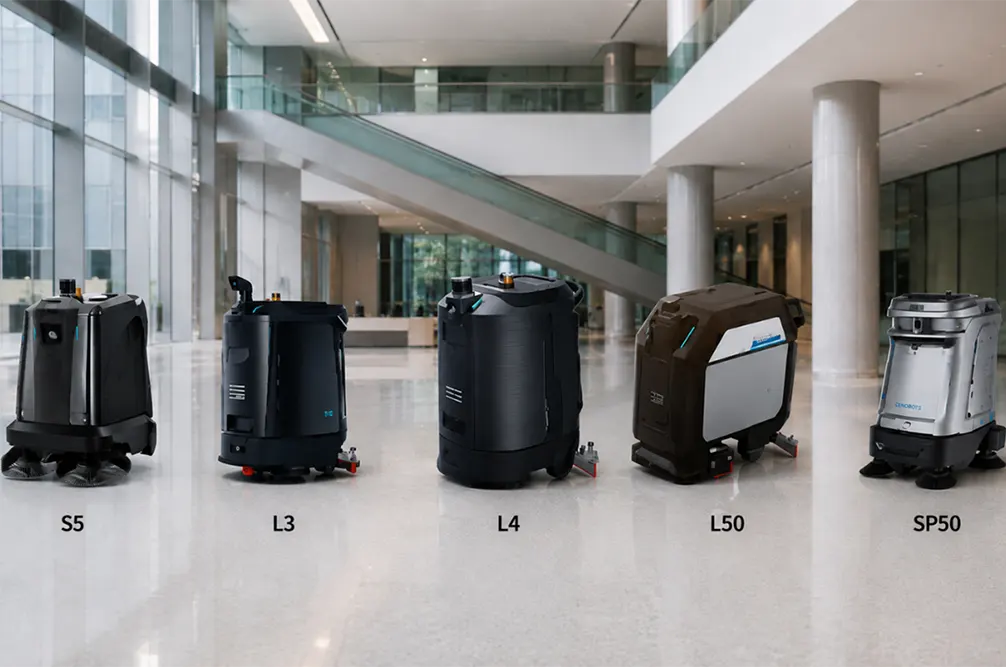
CenoBots AI cleaning robots include five models dedicated to different tasks:
- L3, L4 and L50 they wash and dry hard floors
- S5 collects dry waste
- SP50 vacuums and uses AI Spot Cleaning for targeted dirt removal
The right model is therefore chosen according to the object, the floor, the type of dirt and the method of operation.
There is no single CenoBots robot that is best for every business. In the hospital corridor, compact dimensions, precise movement and work among people are important. In a logistics center, high capacity and dry waste removal may be a priority, while a shopping center may need both hard floor washing and targeted waste removal during business hours.
What are CenoBots AI cleaning robots?
CenoBots AI robots for cleaning are autonomous professional machines intended for the maintenance of business and industrial facilities. They combine washing, vacuuming or sweeping systems with 3D LiDAR, cameras, sensors and AI navigation, allowing them to map space, plan a route, recognize obstacles and carry out cleaning tasks autonomously.
Unlike home robotic vacuum cleaners, CenoBots robots are designed to work on larger surfaces, in more demanding conditions and according to predefined tasks. Depending on the model and purpose, they can perform different types of cleaning and adapt to the characteristics of the facility.
Their key difference compared to classic cleaning machines is not only that they move without an operator.
In order to work autonomously, the robot must determine during the task:
- Where is it located?
- Which route should he take?
- What is in its path?
- How should it react when the conditions in the space change?
That is why a modern professional robot combines a mechanical cleaning system with autonomous navigation. In its commercial scrubber models, CenoBots uses 3D LiDAR, depth cameras, sensors and AI computer systems to map space, plan a safe route and avoid obstacles.
Such a system allows the robot to repeat defined tasks and independently process the surfaces for which it is intended, while employees can focus on jobs that are not practical to automate. This includes, for example, the cleaning of stairs, toilets, hard-to-reach areas and interventions that require human judgment.
How does a robot know where to go?
Using 3D LiDAR, cameras and other sensors, the CenoBots robot forms a digital map of the space and determines its position within it. The navigation system then plans a path through the given zones, keeps track of which parts of the route it has already covered and organizes subsequent passes so that it systematically covers the planned area with minimal overlap.
How does the robot react to people and obstacles during cleaning?
People, carts and vehicles can suddenly alter a planned route, so the robot continuously monitors its surroundings and responds to new obstacles. Its navigation system can slow down, stop or change course. L3 uses 96-channel 3D LiDAR, while the S5 with 32-channel LiDAR also supports vehicle recognition in dynamic environments.
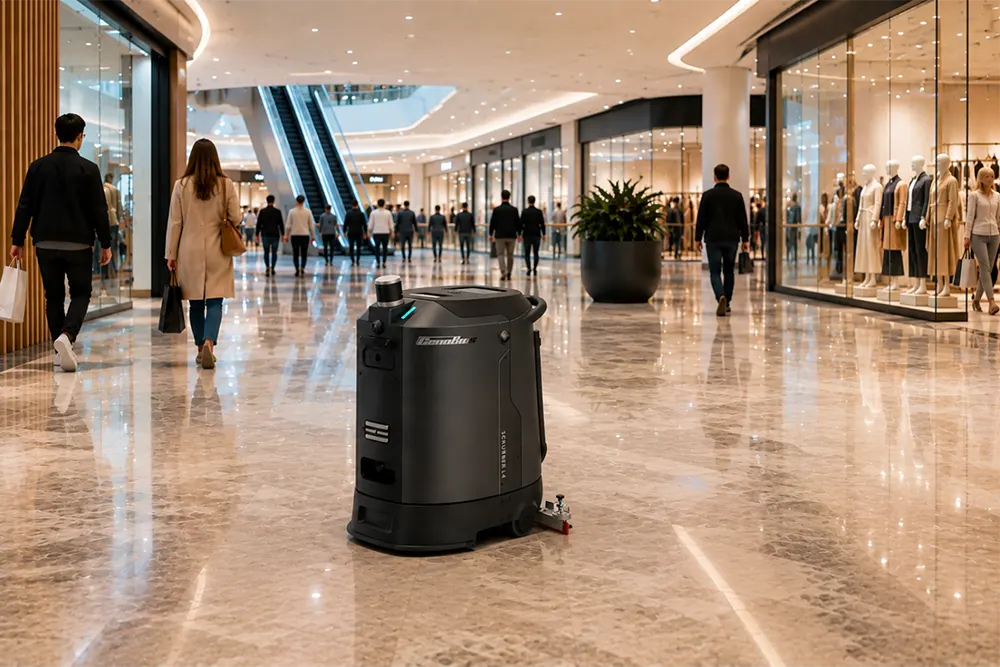
What is the difference between CenoBots L3, L4, L50, S5 and SP50?
L3, L4 and L50 they belong to the same group of robots for washing and drying floors, but they are adapted to different sizes and layouts of spaces.
S5 has a different task: sweeping and collecting dry waste, while SP50 intended for vacuuming and AI Spot Cleaning on hard floors and commercial carpets.
| Model | Type of cleaning | Working width | Capacity | A key advantage | The most suitable facilities |
| L3 | Washing and drying floors | 400 mm | 25 L of clean water | Compactness, precise navigation and passing through more demanding zones | Hospitals, schools, offices, hotels, shops |
| L4 | Washing and drying floors | 450 mm | 38 L of clean water | Cleaning less than 3 cm from the wall and a good balance of capacity and maneuverability | Shopping centers, retail, corridors, health facilities |
| L50 | Washing and drying floors | 510 mm | 55 L of clean water | Greater capacity and performance up to 2,203 m²/h | Warehouses, logistics centers, factories, large sales facilities |
| S5 | Sweeping and collection of dry waste | 820 mm | 50 L of waste | Large working width and output of about 2,500 m²/h | Factories, warehouses, logistics, garages |
| SP50 | Vacuuming and AI Spot Cleaning | Recognition and targeted cleaning of localized impurities | Airports, shopping centers, hotels, hospitals, office buildings |
Which robot suits your facility?
The right CenoBots model depends on the area, type of floor, aisle width, type of dirt, human traffic and required level of autonomy. L3 corresponds to more compact spaces, L4 to medium-sized objects and working along edges, L50 to large hard floors, S5 to the removal of dry waste, while SP50 is intended for vacuuming and targeted treatment of localized dirt.
| If your facility has… | Model | Why this model? |
| Hard floors, narrow aisles and limited maneuvering space | L3 | Compact dimensions and autonomous washing and drying make it suitable for more complex layouts and busy interior spaces. |
| Medium-sized surfaces and many edges along walls, shelves or equipment | L4 | It combines washing and drying with cleaning close to the edges, so it is suitable for commercial spaces with more fixed elements. |
| Large open areas with hard floors | L50 | Larger capacity, working width and longer working time are adapted to cleaning large commercial and industrial areas. |
| Dust, cardboard, small and larger dry waste | S5 | It is intended for autonomous sweeping and collection of dry waste, especially in warehouses, factories and logistics areas. |
| Hard floors and commercial carpets or the need for targeted removal of localized waste | SP50 | It vacuums and uses AI Spot Cleaning to recognize and target areas where waste has appeared. |
Which CenoBots robots can be combined in the same facility?
CenoBots robots can be combined when the facility has different types of surfaces or requires multiple cleaning methods. The L3, L4 or L50 can take on the washing and drying of hard floors, while the S5 can be used for dry waste and the SP50 for vacuuming and targeted AI Spot Cleaning.
| A combination of models | Division of tasks | Suitable for |
| L3 and SP50 | Washing and drying and vacuuming and Spot Cleaning | Hotels, hospitals, office buildings |
| L4 and SP50 | Washing of hard floors and areas along the edges and vacuuming and Spot Cleaning | Shopping centers, airports, larger retail facilities |
| L50 and S5 | Washing large areas and sweeping and collecting dry waste | Warehouses, factories, logistics centers |
| L50 + SP50 | Regular washing of large surfaces and targeted removal of localized dirt | Airports, large commercial facilities |
Is an AI cleaning robot replacing employees?
AI cleaning robot does not replace employees, but takes over the repetitive tasks of cleaning floors. Employees are still needed for restrooms, stairs, hard-to-reach areas, above-floor areas, and jobs that require human judgment. Automation thus enables a different distribution of work: the robot performs planned routine tasks, while the staff is directed to more complex tasks and other priorities of facility maintenance.
According to European Agency for Safety and Health at Work (EU-OSHA), advanced robotics and AI systems can automate repetitive physical tasks, while the way they are applied affects the organization of work and the interaction of employees with technology.
What does the introduction of robots into the facility look like?
The introduction of robots begins with an analysis of the space and the tasks to be automated. After choosing the appropriate model, a map of the facility is formed, cleaning zones, restricted zones and planned routes are defined, then the mode of operation is set and the behavior of the robot is checked in real conditions before regular use.
How is the operation of the robot and the result of the cleaning monitored?
The work of a professional robot does not end when it is released on a given route. CenoBots systems enable digital monitoring of work, including data on completed tasks, cleaned surface, working time and path coverage, while management tools allow monitoring the status and organizing the work of multiple robots.
Such data allows the responsible person to check the execution of tasks without having to physically monitor the robot during the entire cycle. This is especially useful in large facilities and systems where multiple robots work in different zones.
What happens when the robot completes the task?
After the planned cleaning is completed, the further procedure depends on the model, settings and configuration of the system. With compatible models, charging stations and workstations can take over some of the routine operations between cleaning cycles, reducing the need for manual intervention by staff.
For example, L3 with WS3 workstation supports automatic filling, clean water refill, wastewater drain and detergent refill. The S5 supports automatic return to the charging station, which enables a higher level of autonomy during operation.
What can't the CenoBots robot clean?
CenoBots robots automate certain floor maintenance tasks, but are not a substitute for all types of professional cleaning. Stairs, toilets, furniture, vertical and other surfaces above the floor, hard-to-reach areas and specific jobs that require manual labor continue to be part of the jobs performed by staff.
CenoBots AI Cleaning Robots - FAQ
Does the robot have to remap the space every time?
No. The map formed during the introduction of the robot can be used for subsequent tasks, while the robot monitors its environment during operation and reacts to changes. The operator can define clearing zones, restricted zones and desired routes within the mapped area, so complete initial mapping is not required before each task.
What if the layout of the object changes after mapping?
Temporary changes, such as people, carts or moved equipment, are registered by the robot with sensors during operation and adjusts the movement to the current conditions. In the case of significant changes in the layout, it may be necessary to adjust the map, zones or set routes so that the cleaning plan corresponds to the new organization of the space.
Can the CenoBots robot work while people are in the facility?
Yes, CenoBots robots are also designed for dynamic business spaces where people and other equipment move. LiDAR, cameras and other sensors monitor the environment during operation, allowing the robot to register obstacles and adjust its movement, which is important in hospitals, shops, hotels and other traffic facilities.
Is a workstation required for the CenoBots robot to work?
No. An automated workstation is not necessary for every way of using the CenoBots robot, but with compatible models it enables a higher level of autonomy.
Do robots require maintenance?
Yes. Autonomous operation does not eliminate the need for regular maintenance. Brushes, suction elements, filters, tanks and other parts that come into contact with water or dirt require regular inspection and maintenance. CenoBots uses modular and quickly removable components for certain models to make routine maintenance easier.
The choice of robot does not end with the comparison of models and technical specifications. The right solution depends on the space in which the robot will work, the type of floors, the traffic, the cleaning mode and the tasks you want to automate. If you want us to look at these requirements together and evaluate which CenoBots model best suits your facility, we can start from a short analysis of your needs.
About the author:
Milja Tonić SEO Content Strategist & Copywriter
Milja Tonić is an SEO Content Strategist and Copywriter, specializing in the creation of expert content in the field of facility management, professional maintenance of business facilities and automation of cleaning processes.
Through research, SEO strategy and authoring, he develops content on professional hygiene, facility management and the application of autonomous cleaning robots in various business environments.