
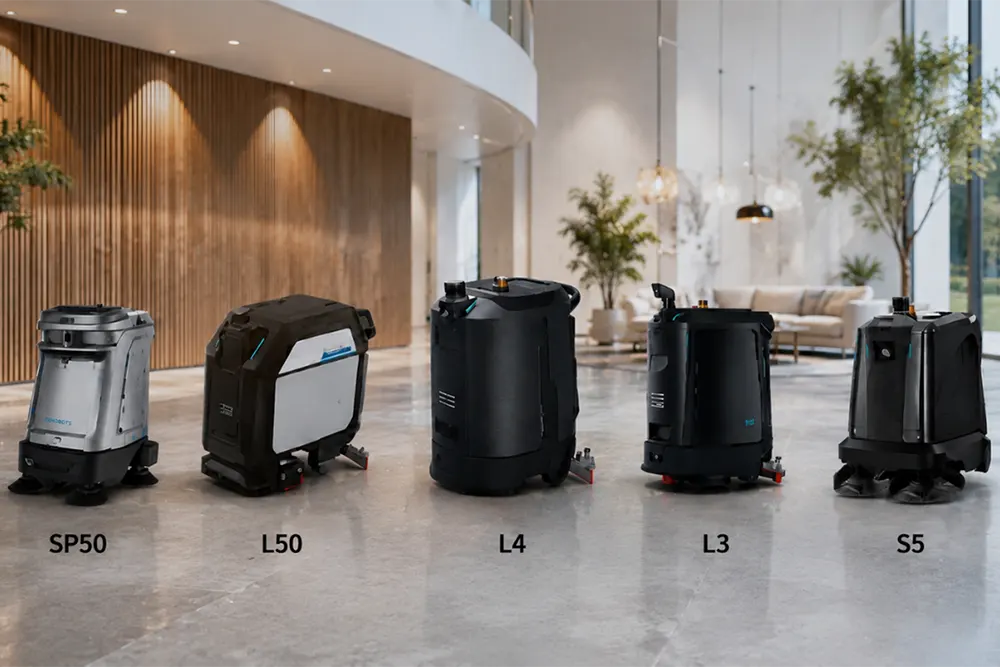
CenoBots robot models for cleaning differ according to:
- type of cleaning
- working width
- capacity
- productivity
- conditions in which they are designed to work
The L3, L4 and L50 wash and dry hard floors, the S5 autonomously sweeps and collects dry waste, while the SP50 vacuums and uses AI Spot Cleaning for targeted cleaning.
The CenoBots offer includes five models:
Although they all belong to professional autonomous floor maintenance robots, their technical characteristics show that they are not intended for the same task.
The differences are seen in the working width, the capacity of the tank or waste container, the theoretical productivity, the method of removing impurities and special functions.
That's why this page presents a technical overview of the models and their most important specifications, while more about the mode of operation and selection AI cleaning robot can be found in a separate guide.
What are the specifications of the CenoBots L3 robot?
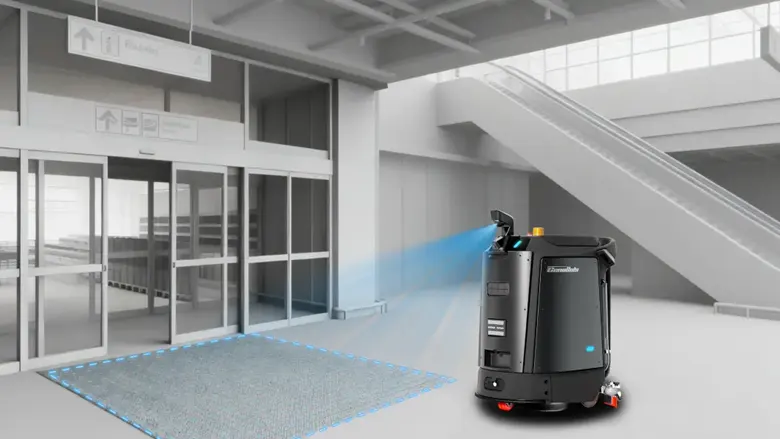
CenoBots L3 is a compact autonomous scrubber dryer with a floor washing width of 400 mm and a minimum passage width of 700 mm. The tanks of clean and wastewater have 25 liters each, the maximum theoretical productivity is 2,016 m²/h, and the battery allows up to four hours of operation in ECO mode..
| Specification | CenoBots L3 |
| Dimensions (L x W x H) | 765 × 572 × 1,000 mm |
| Washing width | 400 mm |
| Minimum minimum aisle width | 700 mm |
| Clean water tank | 25 L |
| Waste water tank | 25 L |
| Brush system | two disc brushes |
| Brush pressure | 18 kg |
| Max. theoretical performance | 2,016 m²/h |
| Max. speed | 1.4 m/s |
| Max. slope | 8% |
| Battery | LFP, 60 Ah / 25.6 VDC |
| Max. working time | up to 4 h in ECO mode |
| Charging time | 1.5-2 hours |
| AI computer | NVIDIA AI, 100 TOPS |
| Navigation and sensors | 96-channel 3D LiDAR + sensor system for detecting obstacles and objects at floor level (cables, carpets) |
One of the most important data in L3 is the relationship between physical width and the space required for autonomous movement. The body of the robot is wide 572 mm, while the minimum minimum aisle width is declared 700 mm. Therefore, these two data should not be equated when planning its application.
L3 can connect to WS3 Workstation, which automates battery charging, clean water refilling, wastewater emptying and detergent refilling. It is also available WT3 Mobile Water Tank, with a capacity of 60 L of clean and 50 L of wastewater.
What are the specifications of the CenoBots L4 robot?
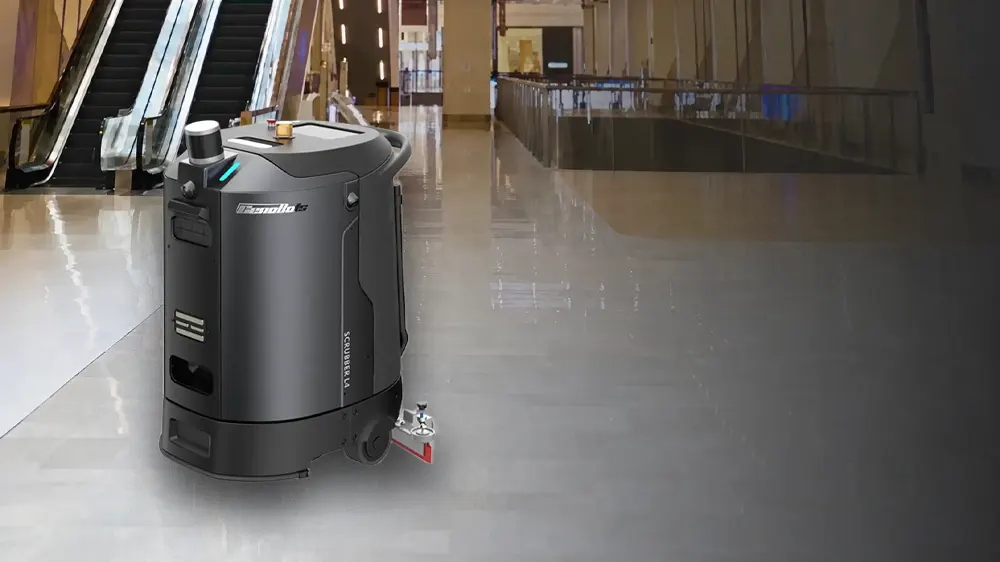
CenoBots L4 is an autonomous scrubber dryer with a floor washing width of 450 mm, a tank of clean water of 38 L and wastewater of 36 L. The maximum theoretical productivity is 1,944 m²/h, while the Smart Flow system and the possibility of cleaning approximately 3 cm from the wall distinguish its technical characteristics.
| Specification | CenoBots L4 |
| Dimensions (L x W x H) | 810 × 615 × 1,075 mm |
| Type of cleaning | washing and drying the floor |
| Washing width | 450 mm |
| The width of the squeegee | 740 mm |
| Clean water tank | 38 L |
| Waste water tank | 36 L |
| Brush pressure | 20 kg |
| Brush speed | 270 RPM |
| Max. theoretical performance | 1,944 m²/h |
| Max. speed | 1.2 m/s |
| Max. slope | 8% |
| Battery | LFP, 70 Ah / 24 VDC |
| Max. working time | up to 4.5 h |
| Charging time | about 2.7 h |
| Noise level | ≥66 dB(A) |
| AI computer | NVIDIA AI, 32 TOPS |
| Navigation and sensors | 32-channel 3D LiDAR (range up to 150 m) + 3D depth camera + bumper sensor + IMU sensor |
| Cleaning along the edge | approximately 3 cm from the wall |
| Flow control | Smart Flow |
Smart Flow relates the solution flow to the speed of the robot. This controls the amount of solution during operation instead of treating the floor with an even flow regardless of movement.
Another characteristic function of L4 is working along the edges. The robot can clean approx 3 cm from the wall, which is relevant in spaces with long wall surfaces, shelves and other fixed elements.
What are the specifications of the CenoBots L50 robot?
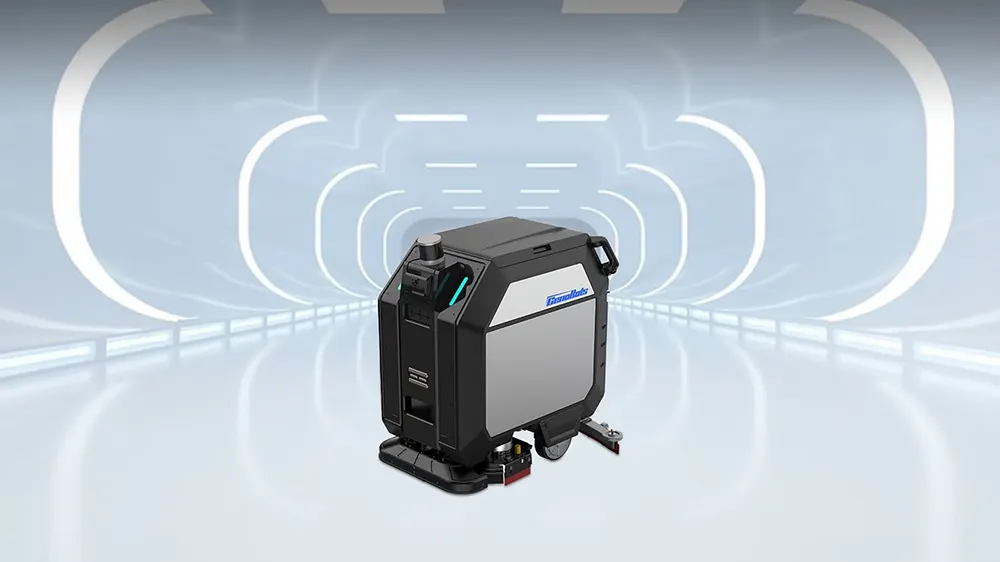
CenoBots L50 is an autonomous washing and drying robot with a working width of 510 mm, a squeegee width of 740 mm and a tank of clean water of 55 liters. The theoretical productivity is about 2,203 m²/h, and the higher capacity and working time of up to six hours distinguish it among CenoBots scrubber models.
| Specification | CenoBots L50 |
| Dimensions (L x W x H) | 1,055 × 580 × 1,045 mm |
| Type of cleaning | washing and drying floors |
| Washing width | 510 mm |
| The width of the squeegee | 740 mm |
| Clean water tank | 55 L |
| Brush pressure | 25 kg |
| Max. theoretical performance | about 2,203 m²/h |
| Max. speed | 1.2 m/s |
| Battery capacity | 120 Ah |
| Max. working time | until 6 a.m |
| AI computer | NVIDIA AI, 32 TOPS ("big model" architecture) |
| Navigation and sensors | 32-channel 3D LiDAR (range up to 150 m) + depth cameras (detection of glass and prominent objects) |
| Consumption control | Save Water / Save Detergent (five-stage filtration, automatic detergent mixing) |
| Space map | automatic update |
Compared to the L3 and L4, the L50 has the largest working width and clean water capacity among these three scrubber models.
Functions Save Water and Save Detergent they are intended to control the use of water and cleaning agents during operation.
L50 also supports automatic map update. When elements such as shelves, displays or other equipment change in the space, the robot can register the change and update the information it uses for navigation.
What are the specifications of the CenoBots S5 robot?
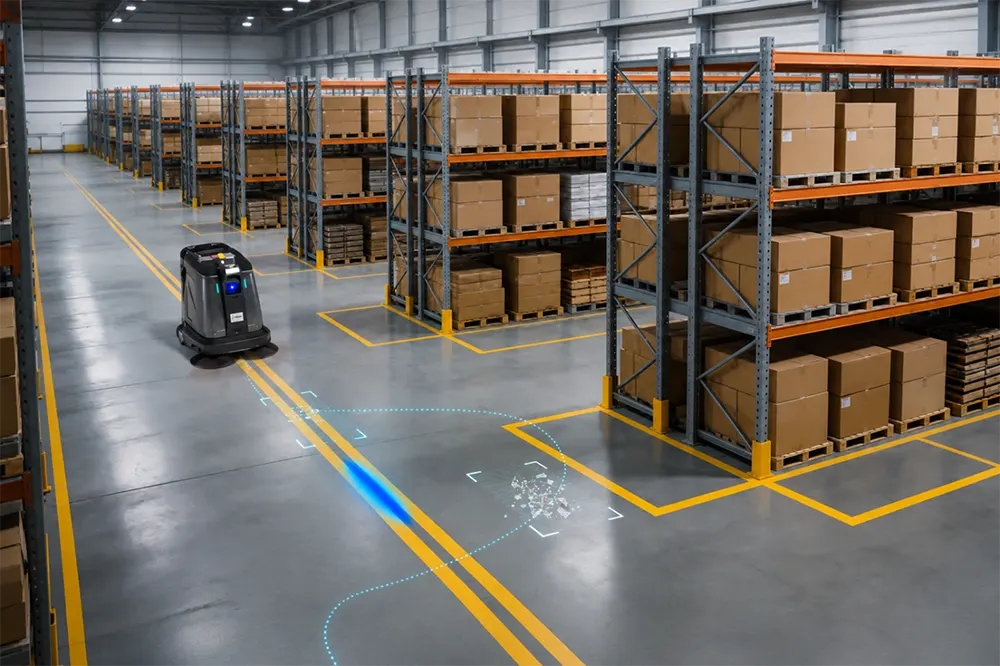
CenoBots S5 is an autonomous AI sweeper with a working sweeping width of 820 mm and a waste container of 50 liters. It is intended for dry cleaning of hard floors, and the theoretical productivity is about 2,500 m²/h. For navigation, it uses a 32-channel 3D LiDAR with a range of up to 150 meters and a system of cameras and sensors.
S5 differs from L3, L4 and L50 in its cleaning system. Do not use water to wash the floor, is already intended for sweeping and collecting dust and dry waste from hard surfaces.
Its sensor system includes a 32-channel 3D LiDAR, depth cameras and other sensors used for mapping, localization and obstacle detection.
Function Vehicle Recognition it is particularly relevant for dynamic industrial environments where the robot shares space with other vehicles and equipment.
| Specification | CenoBots S5 |
| Dimensions (L x W x H) | 1,030 × 720 × 990 mm |
| Type of cleaning | dry sweeping |
| Sweep width | 820 mm |
| Waste container | 50 L |
| Max. theoretical performance | about 2,500 m²/h |
| Max. speed | 1.4 m/s |
| Min. distance from the wall | 0 cm |
| Max. slope | 8% |
| Battery | LFP, 75 Ah |
| Max. working time | 5-7 h |
| Charging time | about 2 hours |
| 3D LiDAR | 32-channel |
| LiDAR range | up to 150 m |
| AI computer | NVIDIA, 100 TOPS |
| Special functions | Vehicle Recognition, Spot Cleaning (up to 4x faster than full coverage), TeamClean, Dynamic Environment Adaptation, Advanced Dust Control (HEPA filtration + automatic filter shaker) |
What are the specifications of the CenoBots SP50 robot?
CenoBots SP50 is an autonomous vacuum sweeper with a cleaning width of up to 720 mm with side brushes and a regular productivity of up to 1,987 m²/h. The AI system recognizes more than 30 types of waste, while Spot Cleaning enables targeted treatment of detected dirt instead of mandatory cleaning of the entire surface.
| Specification | CenoBots SP50 |
| Dimensions (L x W x H) | 855 × 600 × 1,050 mm |
| Type of cleaning | vacuuming and sweeping |
| Width with side brushes | 720 mm |
| Roller brush | 460 mm |
| Dust bag | 18 L |
| Waste container | 5 L |
| Max. suction | 25 kPa |
| Max. speed | 1.2 m/s |
| Min. distance from the wall | <5 cm |
| Max. slope | 8% |
| Maximum cleaning area per hour for complete surface cleaning | up to 1,987 m²/h |
| Maximum cleaning area per hour with the targeted cleaning function | up to 15,550 m²/h |
| AI computer | NVIDIA AI, 32 TOPS |
| Navigation and sensors | 32-beam 3D LiDAR (range up to 150 m) + 3D depth camera + bumper sensor + IMU sensor |
| Detection | more than 30 types of waste |
| Specified detection accuracy | 99% |
| Battery | LFP, 120 Ah / 24 VDC |
| Charging time | 4 h |
| Noise level | ≥58 dB(A) |
| Checking the results | CRC - Cleaning Result Checkup |
The SP50 differs from other models in the way it uses AI waste detection. The code AI Spot Cleaning the system identifies localized dirt and directs the cleaning to the place where it is registered.
Function CRC - Cleaning Result Checkup serves to check the results after the pass and allows reprocessing of the zone when necessary.
It is important to distinguish between two productivity figures. Up to 1,987 m²/h refers to regular cleaning, while up to 15,550 m²/h is the area the robot can patrol in Spot/Patrol mode. The second figure is therefore not directly comparable to the theoretical performance of L3, L4, L50 or S5.
How do the specifications of the CenoBots models differ?
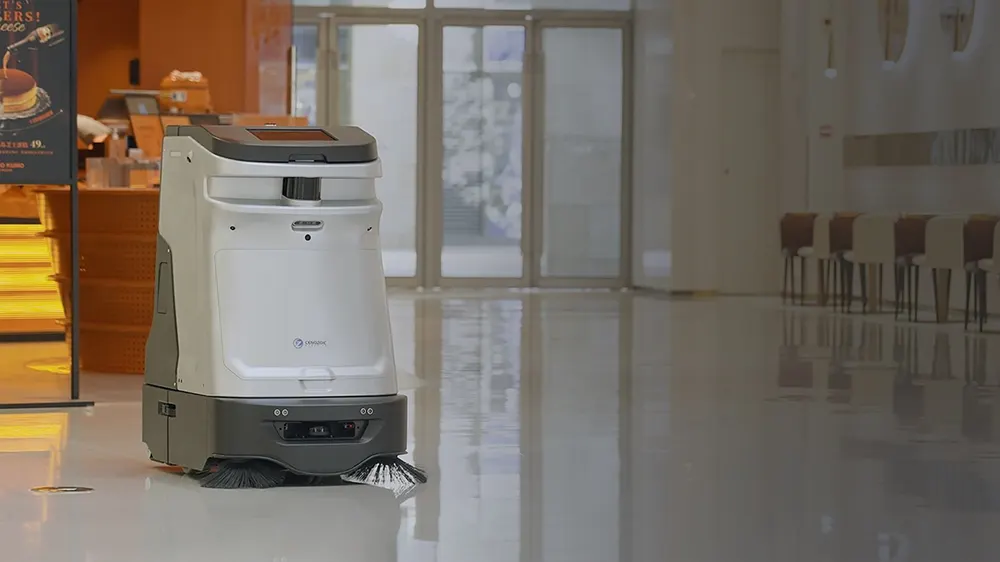
The biggest technical differences between the CenoBots models relate to the way of cleaning, working width, capacity and productivity. The L3, L4 and L50 use wet washing and drying, the S5 is intended for dry sweeping, while the SP50 uses vacuuming and AI debris detection, so their numerical specifications should be compared in the context of the task.
| Characteristic | L3 | L4 | L50 | S5 | SP50 |
| AI computer | 100 TOPS | 32 TOPS | 32 TOPS | 100 TOPS | 32 TOPS |
| Battery capacity | 60 Ah | 70 Ah | 120 Ah | 75 Ah | 120 Ah |
| Charging time | 1.5-2 hours | 2.7 h | not specified | 2 h | 4 h |
| Max. working time | until 4 p.m | up to 4.5 h | until 6 a.m | 5-7 h | 8-13 h |
| Noise level | not specified | ≥66 dB(A) | not specified | not specified | ≥58 dB(A) |
| Max. slope | 8% | 8% | not specified | 8% | 8% |
CenoBots models of cleaning robots - FAQ
What is the TeamClean feature?
TeamClean allows multiple CenoBots robots to work in coordination in the same facility, without the need for the operator to manually coordinate the sequence of their work. With the S5, this is most often used in combination with scrubber-dryer models (L3, L4 or L50) in a so-called "sweep-then-scrub" workflow, the S5 first sweeps the dry waste from the surface, and then the washing robot treats the same area with wet cleaning.
What is Dynamic Environment Adaptation?
Dynamic Environment Adaptation is a function that allows the robot to adapt its route and behavior in real time when changes occur in the space: a moved pallet, a new vehicle or a temporary obstacle that was not part of the original map. With the S5, this function is particularly relevant for large industrial plants where the schedule changes from shift to shift.
What is Advanced Dust Control with the S5?
Advanced Dust Control combines strong suction power with HEPA filtration and an automatic "shaker" mechanism that regularly cleans the filter during operation, preventing it from clogging. This combination allows the S5 to efficiently collect both fine dust and larger industrial waste without a drop in suction power during prolonged operation.
What is the difference between CenoBots S5 and SP50?
The S5 is primarily an autonomous sweeper for dry sweeping of larger areas, while the SP50 combines vacuuming, sweeping and AI waste detection for Spot Cleaning.
The right choice does not start with the specification, but with the space and the task to be automated. If you want to see which solution best suits your surfaces, way of working and cleaning requirements, we can start with a short one analysis of your needs. The right model is the one that fits naturally into the daily operation of the facility.
About the author:
Milja Tonić – SEO Content Strategist & Copywriter
Milja Tonić is an SEO Content Strategist and Copywriter, specializing in the creation of expert content in the field of facility management, professional maintenance of business facilities and automation of cleaning processes.
Through research, SEO strategy and authoring, he develops content on professional hygiene, facility management and the application of autonomous cleaning robots in various business environments.