
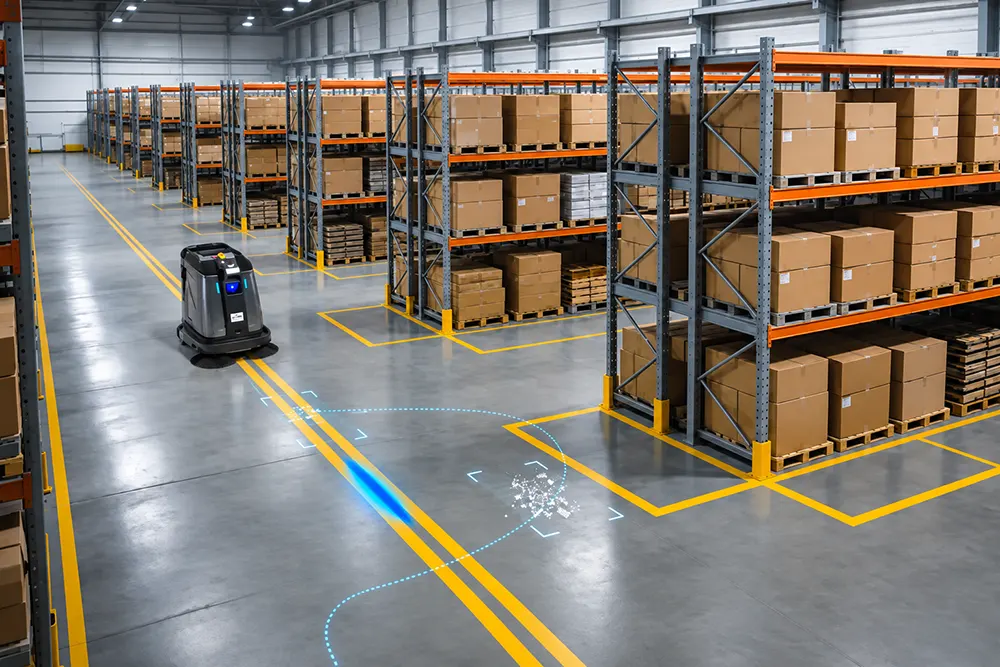
How does a robot sweeper clean large areas? CenoBots S5 is an autonomous robot for dry sweeping of large business and industrial areas. With a sweeping width of 820 mm, a waste container of 50 liters and a maximum theoretical output of about 2,500 m²/h, it removes dust and loose waste in facilities such as warehouses and factories.
The S5 does not wash under water. Its task is to collect dry dirt, including:
- fine dust
- paper
- plastic bottles and bags
- packaging film
- wood remains
- and small metal scrap
The S5 is one of five CenoBots models designed for various professional maintenance tasks. If you want to compare its purpose with washing, drying and vacuuming robots, read our guide: CenoBots models of cleaning robots, with an overview of specifications and areas of application.
How does the S5 know where to go?
The S5 uses a 32-channel 3D LiDAR with a declared detection range of up to 150 meters and an NVIDIA AI platform of 100 TOPS. This system allows the robot to map the space, determine the position and autonomously move through industrial zones where racks, pallets, equipment, people and vehicles are located.
Function Dynamic Environment Adaptation allows the robot to adapt its route and behavior to changes in the environment. This is especially important in warehouses and factories, where the arrangement of obstacles is not always the same.
How does the S5 react to forklifts and other vehicles?
The S5 uses the feature Vehicle Recognition for the recognition of forklifts, AGV vehicles and other vehicles in the work area. By combining AI systems and 3D LiDAR perception, the robot detects and avoids them, allowing it to move autonomously in dynamic industrial environments where traffic continues during cleaning.
However, this does not mean that planning is not necessary. Work zones and robot routes should be coordinated with the organization and safety rules of the specific facility.
How does the S5 prevent dust from re-scattering?
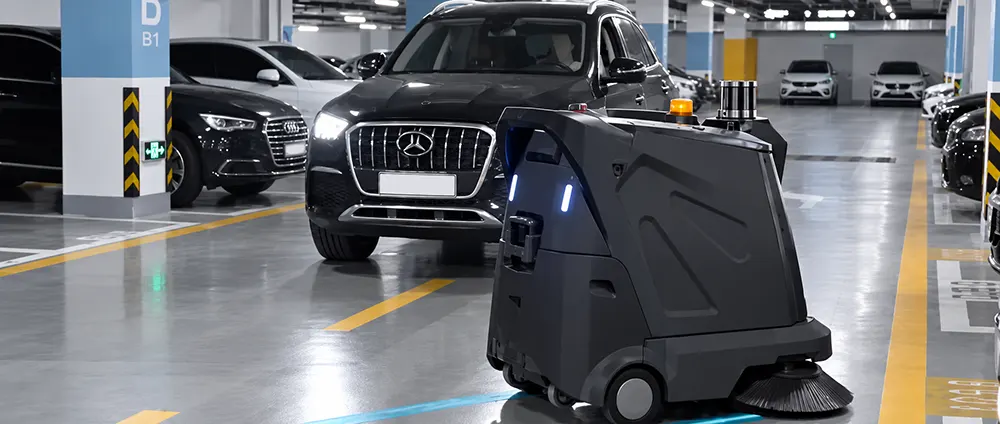
S5 has Advanced Dust Control a system that combines suction and filtration for more efficient collection of fine dust and other dry waste. It is especially useful in factories, warehouses and garages, where the goal of sweeping is not just to move dirt off the floor, but to collect it while controlling dust.
CenoBots in its industry guide further states HEPA filtration and automatic filter cleaning system, which is significant for surfaces on which fine dust is continuously generated.
What does the S5 do when only one part of the surface is heavily soiled?
The Spot Cleaning function allows the S5 robot to focus on localized areas with a higher amount of dirt. Instead of repeating the complete cycle over the entire surface, the robot can focus cleaning on problem areas, which is useful around goods reception, loading zones, entrances and other places where waste occurs more often.
In this way, a large area does not have to be treated in the same way everywhere.
Can multiple S5 robots clean a large area together?
Yes. TeamClean allows the S5 to be included in a coordinated cleaning system for large areas. The S5 can remove dust and loosen debris, while a CenoBots washing robot, like the L50, then washes and dries the hard floor surface. Thus, different maintenance phases can be connected in one organized process.
Where does the S5 make the most sense?
S5 is intended for large areas where dust and loose dry waste regularly appear. CenoBots recommends it for warehouses, logistics centers, factories, large retail establishments and parking garages, where wide aisles, large square footage and repetitive sweeping create good conditions for autonomous operation.
Before choosing a model, it is therefore necessary to evaluate the type of waste, the square footage, the width of the passage, the layout of the equipment and the intensity of the traffic, and not just the declared performance of the robot.
| Feature S5 | Data | Significance for large areas |
| Sweep width | 820 mm | Greater coverage in one pass |
| Max. theoretical performance | about 2,500 m²/h | Faster processing of large areas |
| Waste container | 50 L | Fewer interruptions to empty the bin |
| 3D LiDAR | 32 channels, range up to 150 m | Mapping and autonomous navigation |
| AI platform | NVIDIA, 100 TOPS | Data processing and decision-making in real time |
| Fast charging | about 2 hours | Shorter break between cycles |
| Spot Cleaning | Yes | Targeted cleaning of dirty areas |
| Vehicle Recognition | Yes | Vehicle detection and avoidance |
| TeamClean | Yes | Coordinated work of multiple robots |
| Advanced Dust Control | Yes | Suction and filtration of fine dust |
CenoBots S5: How does a sweeping robot clean large areas? - FAQ
Does the S5 clean floors?
No. S5 is intended dry sweeping and waste collection. When wet washing and drying of the hard floor is required after sweeping, they are used CenoBots L3, L4 or L50 models.
Can the S5 completely replace manual cleaning?
No. The S5 can take over repetitive sweeping of available floor areas, while staff remain needed for hard-to-reach areas, robot maintenance and other non-machine tasks.
How is the CenoBots S5 charged during autonomous operation?
The S5 uses a compatible CS5 station for automatic charging. When the battery level becomes low, the robot goes to the station on its own and starts charging, without the need for staff to plug it in manually. After recharging the battery, it can continue the previously started task, which enables longer autonomous cleaning cycles of large areas. A quick charge of approximately two hours is specified for the S5.
Large areas. Less repetition. Smarter cleaning.
The S5 takes over the routine sweeping of large floor areas, while your team stays where they're really needed.
See how the S5 would work in your facility.
About the author:
Milja Tonić – SEO Content Strategist & Copywriter
Milja Tonić is an SEO Content Strategist and Copywriter, specializing in the creation of expert content in the field of facility management, professional maintenance of business facilities and automation of cleaning processes.
Through research, SEO strategy and authoring, he develops content on professional hygiene, facility management and the application of autonomous cleaning robots in various business environments.