
Where are CenoBots robots used? CenoBots robots are used in
- stores,
- shopping centers
- hotels
- hospitals
- schools
- offices
- factories
- warehouses
- transport facilities
- and garages.
The choice of model depends on the type of floor, the width of the passage, the amount and type of waste and whether the facility needs washing, sweeping, vacuuming or targeted cleaning of dirty areas.
What task does each CenoBots model perform?
The CenoBots offer consists of five models:
- L3, L4 and L50 wash and dry hard floors
- S5 is intended for dry sweeping and removal of loose waste from large areas
- The SP50 vacuums and enables targeted cleaning of locally soiled areas, such as carpets and frequent passages
Therefore, the same model is not optimal for every object.
For a detailed overview of the technology and specifications, read our Master Guide: CenoBots AI cleaning robots
Which robot corresponds to which type of object?
The choice of CenoBots model depends on the type of object, type of floor and type of soiling.
The table below shows which models to consider for each type of space, from shops and malls to factories, warehouses, airports and garages, with a brief explanation of why they are recommended.
| Object type | Models | Why |
| Shops and supermarkets | L3, L4, SP50 | washing aisles and sales areas, working in a complex area, targeted cleaning |
| Shopping centers | L4, L50, SP50 | large hard surfaces, corridors, entrances and local soiling |
| Hotels | L3, L4, SP50 | corridors, lobbies, hard floors and carpets |
| Hospitals and health institutions | L3, L4, SP50 | corridors, waiting rooms, lobbies and various floor coverings |
| Schools and universities | L3, L4, L50 | corridors, common and larger open areas |
| Offices | L3, L4, SP50 | hard floors, corridors, common and carpeted areas |
| Factories | L50, S5 | washing of industrial floors and removal of dry waste |
| Warehouses and logistics centers | L50, S5 | large areas, logistics routes, dust and waste |
| Airports and transport facilities | L4, L50, SP50 | mixed traffic, large communication areas and local pollution |
| Parking garage | S5, L50 | dust and loose waste, with the possibility of washing the hard floor |
How are CenoBots robots used in stores and supermarkets?
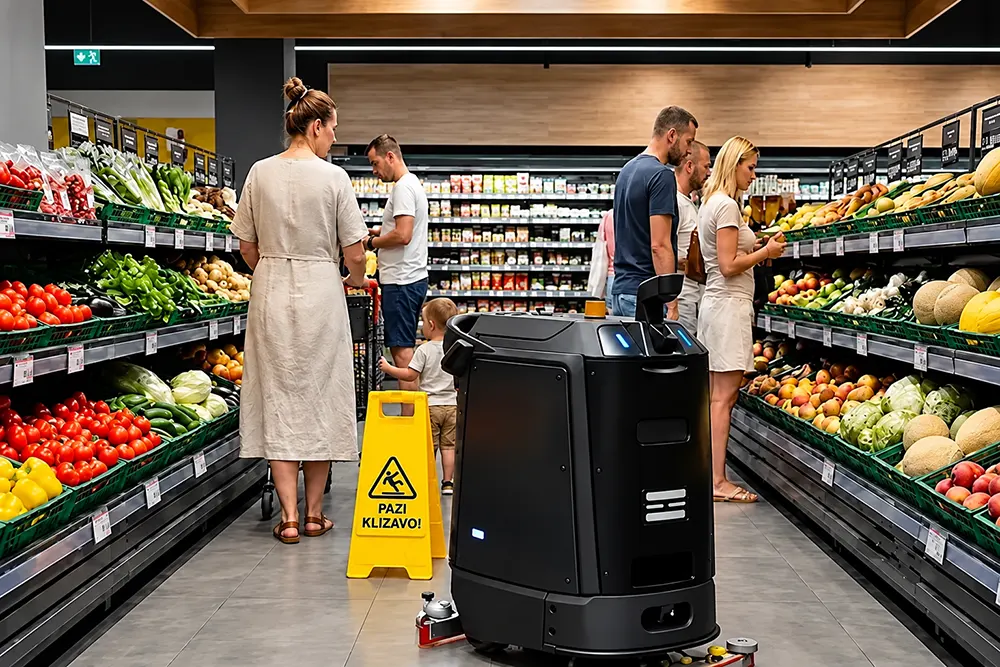
In stores and supermarkets, CenoBots robots clean sales aisles, areas around cash registers and entrances, with autonomous navigation around customers and carts. L3 and L4 wash and dry hard floors, while SP50 vacuums and specifically removes local stains that appear during the day in high-traffic areas.
L3 has a minimum passage width of 700 mm and a clearing width of 400 mm, suitable for narrow passages; L4 has a cleaning width of 450 mm and a tank of 38 L, for larger sales areas.
Which robots are suitable for shopping malls?
L4, L50 and SP50 are suitable for shopping centers. L4 washes and dries medium-sized and more complex floor surfaces, L50 covers large open surfaces and main communications, and SP50 vacuums and cleans targeted local soiling in high-frequency entrance and passage zones.
The L50 has a performance of up to 2,203 m²/h with a cleaning width of 510 mm, which makes it the most generous model in this category of facilities.
How are robots used in hotels?
In hotels, L3 and L4 clean hard floors in lobbies, corridors and common areas, while SP50 vacuums carpets and rugs. The choice should not be based only on the square footage of the hotel, but on the combination of floor coverings, the width of communication zones and the proportion of carpets in the building.
For smaller and more complex surfaces, the L3 has the advantage of a passage of 700 mm, while the L4 takes on larger hard zones.
Which CenoBots robots can be used in hospitals and healthcare facilities?
For hospital corridors, lobbies and waiting rooms with hard floors, the L3 and L4 are considered, while the SP50 vacuums carpets and similar areas. The robot performs routine floor washing, but its work does not replace the disinfection of contact points or the institution's complete hygiene protocol, which remains the responsibility of the staff. CDC Guidelines for Cleaning Healthcare Facilities they also define procedures for floors and high-contact surfaces separately.
L3 is a compact model for narrow corridors, while L4 covers medium-sized healthcare spaces and communication zones.
How are robots used in schools and universities?
In schools and universities, L3 is suitable for narrow corridors and smaller common areas, L4 for larger communication and student areas, and L50 for large campuses with spacious hard floors. The choice depends on the layout of the facility, the square footage and the time when cleaning can be organized.
Schools have alternating periods of intense movement and empty corridors, so the robot's work schedule is as important as its capacity.
Are CenoBots robots suitable for office facilities?
Yes. In offices, the L3 and L4 maintain hard floors in corridors, entrances and common areas, while the SP50 is more suitable for vacuuming carpets and meeting rooms. When choosing, it is more important to analyze the layout and floor coverings than just the total area of the office building.
Facilities with hard floors in entry areas and carpets in work areas often require a combination of models, not just one solution.
Which robots are suitable for factories and production facilities?
In factories, the L50 washes large hard floor surfaces, while the S5 removes dust and loose waste from production and logistics routes during the working day. When the facility requires both dry waste removal and floor washing, these two models perform different phases of maintaining the same surface.
The S5 has a sweeping width of 820 mm, a waste container of 50 L and an output of about 2,500 m²/h, which makes it the flagship model for industrial facilities.
How are CenoBots robots used in warehouses and logistics centers?
For warehouses and logistics centers, S5 and L50 are relevant. The S5 dry sweeps away dust and loose waste from logistics routes and loading areas, while the L50 washes large hard floors. The model is chosen according to the type of soiling, and not only according to the size of the warehouse.
Pallets, packaging and intensive movement of goods create a different load on the floor than in a commercial facility, so a combination of both models often gives the best result.
Which robots can be used in airports and transport facilities?
At airports and other large transport facilities, the L4 covers mixed traffic areas, the L50 covers spacious hard floors, while the SP50 takes over vacuuming and targeted waste removal in high-traffic areas. The choice depends on the floor covering, the width of communications and the changing intensity of passengers during the day.
Can CenoBots robots clean parking garages?
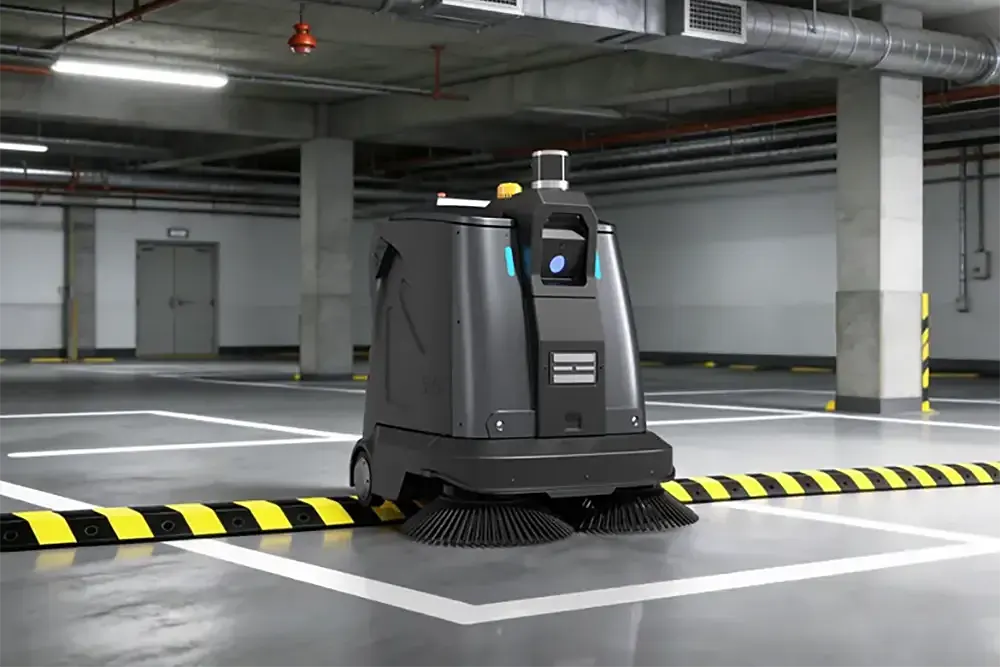
Yes. The S5 is particularly relevant for parking garages, intended for dry sweeping of dust and loose waste from large hard surfaces. When periodic floor washing is also required, a suitable scrubber such as the L50 is considered, in accordance with the layout and requirements of the specific garage.
Slopes, ramps, thresholds and vehicle traffic should be checked during the site assessment, as not all parts of the garage are equally suitable for autonomous operation.
Where to use CenoBots robots - FAQ
Can multiple CenoBots models be used in one facility?
Yes. A large facility may have several types of floors and different cleaning tasks, so a combination of models is often more practical than a single universal robot. The S5 removes loose waste, the L50 washes hard floors, while the SP50 maintains carpets and responds to localized soiling.
What should be checked before choosing a robot for a specific object?
Before choosing, you should check the total and actually available area for cleaning, the type of floor covering, the narrowest passages, the type of soiling, obstacles, the intensity of movement of people or vehicles and the available time for work. Only by connecting this data with the task, the appropriate model is selected.
Can a robot completely replace cleaning staff?
No. The CenoBots robot automates repetitive tasks such as washing large floor areas, sweeping or vacuuming, but personnel remain necessary for detailed cleaning, disinfection, hard-to-reach places and situations outside the autonomously defined task. The robot takes over part of the process, not the complete maintenance of the facility.
The right model starts with the space it needs to clean.
Square footage is just the beginning. The type of floor, the width of the aisle, the arrangement of the object and the type of soiling determine which CenoBots model makes the most sense in a particular space.
Check which CenoBots model fits your facility
About the author:
Milja Tonić SEO Content Strategist & Copywriter
Milja Tonić is an SEO Content Strategist and Copywriter, specializing in the creation of expert content in the field of facility management, professional maintenance of business facilities and automation of cleaning processes.
Through research, SEO strategy and authoring, he develops content on professional hygiene, facility management and the application of autonomous cleaning robots in various business environments.