
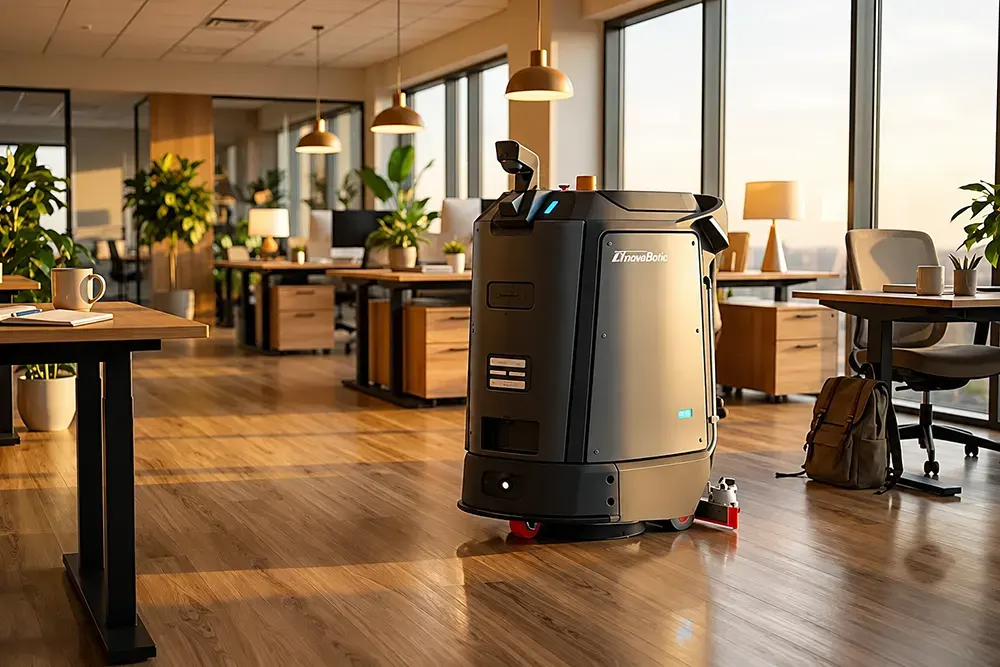
CenoBots L3 is a compact autonomous robot for washing and drying hard floors, designed for small and medium-sized spaces where passages, corridors and zones between equipment are limited. With a minimum aisle width of 700 mm, a working width of 400 mm and AI navigation, it can work where larger machines do not have enough space to maneuver effectively.
This makes it particularly suitable for hospitals, schools, hotels, office corridors, smaller shops and other facilities where a large open area is not a major challenge. In relation to others CenoBots cleaning robot models, L3 stands out for its compact dimensions and the ability to work in limited space.
With L3, the advantage is not only in dimensions, but in the combination of a compact housing, autonomous navigation and a system for washing and drying the floor.
How does the CenoBots L3 wash and dry the floor?
L3 is a scrubber-dryer robot: it applies a cleaning solution to a hard floor surface, mechanically processes the dirt with brushes, and then removes the dirty solution from the floor with a water collection system. It has a working width of 400 mm, brush pressure of 18 kg and separate tanks for clean and wastewater with a capacity of 25 liters each.
Its maximum theoretical output is approx 2,016 m²/h. This data represents the declared theoretical capacity, while the actual productivity in the facility depends on the layout of the space, obstacles, routes and cleaning conditions.
Unlike S5, which is intended for dry sweeping and collection of loose waste, L3 is intended washing and drying hard floor surfaces.
How does the L3 know where to move in a confined space?
The L3 combines 3D LiDAR with NVIDIA's 100 TOPS AI platform for autonomous positioning, path planning and navigation through more complex indoor spaces. The system allows the robot to follow the planned route and adapt the movement to the layout of the space, which is especially important in corridors, aisles between shelves and other restricted areas.
The importance of combining sensors, localization and path planning for the autonomous movement of mobile robots was also investigated within the EU project CROWDBOT, especially in changing spaces where the robot moves between people and obstacles.
What does L3 do when there is an obstacle in its path?
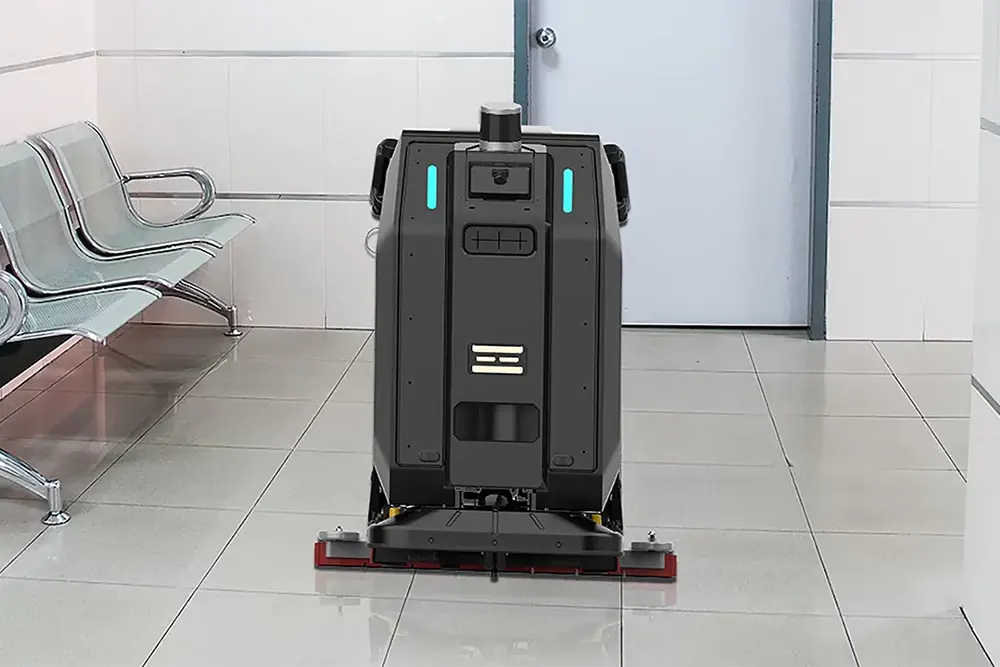
When an obstacle appears in the path, L3 uses the perception system to detect it and adjust the movement. CenoBots specifically mentions recognition of standard obstacles, but also objects near the floor, such as cables and temporary carpets. This reduces the risk of getting stuck during autonomous operation in a changing space.
This is precisely what is important for hospitals, schools, shops and offices. However, autonomous obstacle avoidance does not mean that the robot can clean a physically inaccessible surface. The space below or behind an obstacle that blocks access remains outside his work zone until it becomes available again.
What features make everyday use of the L3 robot easier?
The L3 is not only designed for autonomous navigation, but also for easier everyday handling. CenoBots touts one-touch controls, voice commands, magnetic brushes and a quick-release wiper. These features simplify task initiation and regular maintenance of the robot after cleaning cycles are completed.
Voice control enables commands such as starting and stopping cleaning, following the operator and returning to base. CenoBots introduced i Quick Demo Mode, intended for quick launch without prior mapping and setup, primarily for demos and short tasks.
Magnetic brushes and a quick-release wiper system have a different role: they facilitate access to components that require regular maintenance.
How does L3 reduce manual work around water, detergent and filling?
The L3 can use the WS3 workstation that integrates automatic battery charging, clean water refilling, wastewater emptying and detergent addition. This automates part of the work between cleaning cycles, so the staff does not have to manually connect the robot and manage the tanks every time.
For facilities where proper water connections are not available in a convenient location, CenoBots also specifies a mobile capacity tank 60 L of clean and 50 L of wastewater.
This does not mean that the L3 is completely maintenance-free. Brushes, wipers, reservoirs and other parts still require regular checks and cleaning.
Where does the advantage of the compact L3 come to the fore?
L3 makes the most sense in small and medium facilities with hard floors, narrow aisles and more complex layouts. It is most often recommended for hospitals, schools, hotels, shops, small supermarkets, office corridors and similar commercial areas where maneuvering space and the ability to pass are more important than a large cleaning width.
In hospitals, its compact construction suits corridors, waiting rooms and other available hard surfaces. In schools, it can be used in corridors and common areas, while in smaller stores, the narrower construction makes it easier to move between the shelves.
Hotels and offices have a similar problem: the area does not have to be small, but it can be divided into a large number of corridors and communication zones. That is why the choice of robot should be based on the smallest passage width, and not only on the total number of square meters.
CenoBots L3: key features for limited space
| Characteristic of L3 | Data | Why is it important? |
| Passing width | 700 mm | Enables work in narrow passages |
| Cleaning width | 400 mm | A more compact grip for more complex areas |
| Dimensions | 765 × 572 × 1,000 mm | Smaller housing makes it easier to maneuver |
| Clean water tank | 25 L | It reduces the need for frequent refills during the cycle |
| Brush pressure | 18 kg | Mechanical processing of the hard floor |
| Max. theoretical performance | about 2,016 m²/h | Productivity despite compact dimensions |
| AI platform | NVIDIA, 100 TOPS | Data processing for autonomous navigation |
| 3D LiDAR | Yes | Support for mapping, navigation and spatial perception |
| WS3 station | Compatible | Filling, water, emptying and detergent |
Is the L3 a better choice than a larger robot for every facility?
No. The advantage of the L3 comes to the fore when the layout of the space requires compact dimensions and maneuvering through narrow passages. For large open areas, wider models can have a more practical working width and larger capacities. That is why the model is chosen according to the combination of square footage, width of passage, layout of obstacles and type of task.
For example, CenoBots L50 is positioned for larger industrial and commercial areas, while L4 intended for medium spaces and more precise cleaning of edges. L3 fills a different niche: autonomous washing where space is limited.
Therefore, "bigger" does not automatically mean "better". A robot that has a larger working width on paper has no advantage if it cannot practically pass through key parts of the object.
How does CenoBots L3 work where big bots can't? - FAQ
Can L3 completely replace cleaning staff?
No. The L3 can automate the repetitive washing of accessible hard floors, while staff remain needed for stairs, hard-to-reach areas, detailed cleaning, robot maintenance and other non-machine tasks. CenoBots also presents its autonomous robots as a complement to the work of staff, rather than a universal replacement for all cleaning jobs.
How long can CenoBots L3 work on a single charge?
CenoBots L3 can work up to about 4 hours in ECO mode, depending on settings and operating conditions. It uses an LFP battery with a capacity of 60 Ah / 25.6 V, while charging takes approximately 1.5 to 2 hours. The actual duration of the cycle depends on the cleaning mode and the load of the robot.
Can the L3 work on gently sloping floors?
Yes. CenoBots L3 can work on a slope of up to approx 8%, which is useful in buildings with gentle ramps or transitions between zones. This does not mean that it is intended for steep ramps or stairs, but for surfaces that remain within the declared movement limits.
Compact where it needs to be. Autonomous where it matters.
Discover what L3 can do in your facility.
About the author:
Milja Tonić – SEO Content Strategist & Copywriter
Milja Tonić is an SEO Content Strategist and Copywriter, specializing in the creation of expert content in the field of facility management, professional maintenance of business facilities and automation of cleaning processes.
Through research, SEO strategy and authoring, he develops content on professional hygiene, facility management and the application of autonomous cleaning robots in various business environments.