
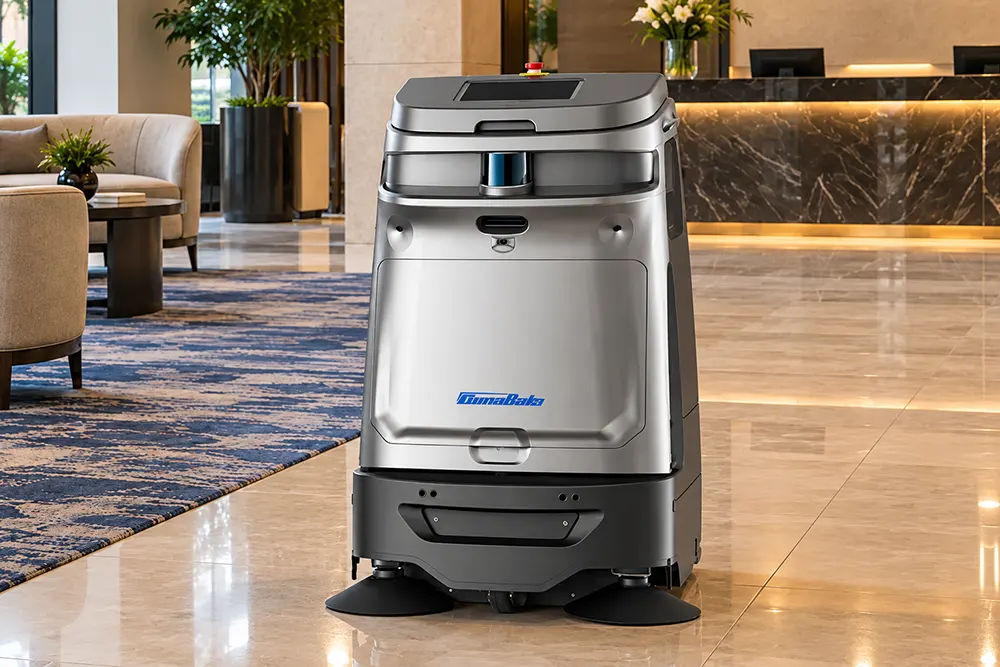
How does targeted AI floor cleaning work? CenoBots SP50 is an autonomous robot for vacuuming and sweeping that can systematically clean the planned surface, while AI Spot Cleaning allows it to additionally react to observed dirt. The robot recognizes the waste on the floor and can direct the cleaning to a specific zone, which complements the targeted cleaning with regular maintenance of the entire surface.
Such a working principle is particularly interesting for objects in which dirt does not appear evenly throughout the day. SP50 combines AI Intelligent Recognition, strong suction of 25 kPa, autonomous navigation and the ability to work on hard floors and carpets. The manufacturer states a maximum working time of up to 13 hours, depending on the conditions and mode of use.
The SP50 is intended for vacuuming and sweeping, while other models take on different floor maintenance tasks. Comparison of CenoBots cleaning robot models shows their key differences and helps to choose a model according to the object.
How does the robot recognize where it should clean?
The SP50 uses an AI recognition system to identify dirt during operation and react to its location. Spot Cleaning is therefore not just a pre-defined route: the robot uses sensors and algorithms to detect waste and then dynamically adjust its movement to pick it up instead of needlessly cleaning the entire surrounding area.
This is an important distinction between navigation and recognition of impurity. The map tells the robot where it can move, while AI perception allows it to react to what is on the floor during operation.
According to the manufacturer's current specifications, the declared recognition accuracy is up to 99%. This information should be viewed as a manufacturer's specification, and not as a guarantee of identical results in every facility.
Does the CenoBots SP50 work on carpet or only hard floors?
CenoBots SP50 can work on both hard floors and carpets, making it suitable for facilities with different floor surfaces. Since it is a vacuum sweeper robot, its task is vacuuming and collecting dry dirt, not wet scrubbing the floor like the CenoBots scrubber-dryer model.
That's exactly why SP50 differs from the model L3, L4 and L50. If the facility requires washing the hard floor with water and a suitable brush system, a scrubber-dryer is chosen. If they are a priority carpets, hard surfaces and targeted removal of dry waste, SP50 has a different role.
How quickly can it react to local impurity in a large facility?
The SP50 is designed so that targeted cleaning reduces the amount of unnecessary passing through already clean zones. CenoBots for Spot Cleaning states a maximum theoretical productivity of up to 15,550 m²/h, but this does not mean that the robot physically vacuums every square meter of such a large area in one hour.
The high figure results precisely from a different working principle: the robot can move through a larger area and intervene where cleaning is required.
How much suction power does the CenoBots SP50 have?
CenoBots lists a suction power of 25 kPa for the SP50. Combined with a 460mm long roller brush and a total cleaning width of 720mm, the system is designed to pick up dry dirt from commercial floor surfaces, while AI determines where targeted cleaning is needed.
SP50 has 5 liter waste container and 18 liter filter bag. These are important data when evaluating the model for the facility, because the capacity of the collection system should be considered together with the type and amount of waste that actually appears in the area.
How long can CenoBots SP50 work without charging?
CenoBots for the SP50 lists a maximum run time of up to 13 hours. The actual time between charges depends on the way of use, the task and the conditions in the facility, so the maximum value should not be interpreted as a fixed duration of each work cycle. The robot is designed for autonomous recharging.
How does it cope when the layout of the space changes?
The SP50 supports automatic map updating, allowing it to take into account changes in the operating environment without relying solely on the initially created map. This is important in commercial facilities where the position of equipment, furniture or other elements may change during daily work.
Safe movement does not depend only on the map. CenoBots for SP50 lists detection of up to 150 meters, as well as systems for the detection of protruding objects and glass surfaces. These functions serve navigation and perception of the environment, while AI Spot Cleaning has another task - finding places that need cleaning.
How close to the edges can the SP50 clean?
According to the manufacturer's specification, the SP50 can clean at a distance of less than 5 cm from the edge. This allows the robot to approach the perimeter of the space during autonomous operation, while the actual result with walls and obstacles depends on the geometry of the zone and the conditions in which the robot moves.
Can the operation of the robot be controlled via the application?
Yes. The mobile application allows tracking the movement and current location of the SP50, viewing important work information, planning routes and receiving notifications about completed tasks. Thus, the operator can supervise the cleaning without having to physically follow the robot through the facility during each work cycle.
The application therefore does not replace the AI perception of the robot, but rather serves management and supervision. The SP50 independently performs the task on the floor, while the responsible person receives an overview of its work through the application and can more easily organize the cleaning of different zones.
For which facilities is CenoBots SP50 intended?
The SP50 is intended for commercial spaces where it is necessary to autonomously maintain hard floors or carpets and react to dirt that appears during the day. CenoBots lists hotels, hospitals, retail, and educational facilities among its application scenarios, while introducing it for other high-traffic commercial spaces.
What to check before buying CenoBots SP50?
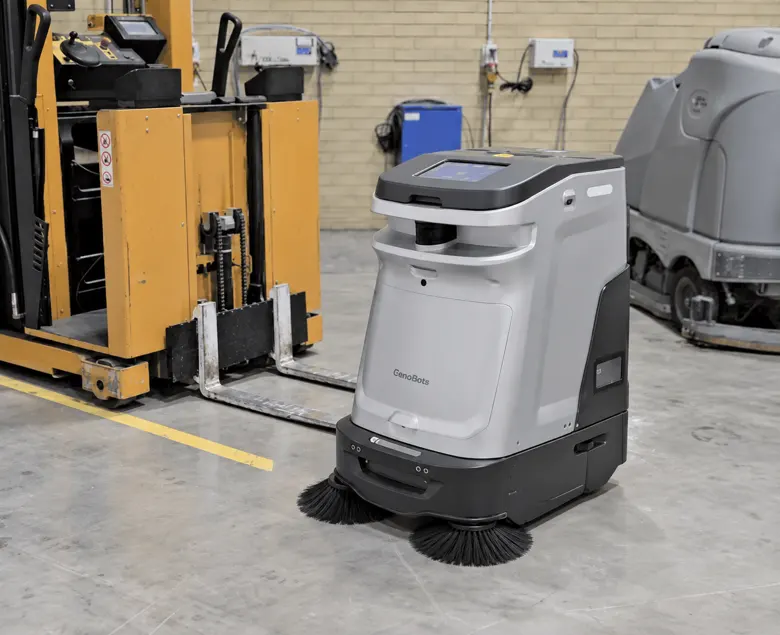
Before purchasing the SP50, you should check the types of floors, the area and layout of the facility, the type and amount of dirt, the width of the passage, the expected working time and the ratio between Spot Cleaning and full-coverage tasks. Only when these conditions are compared with the capabilities of the robot can it be assessed whether it is suitable for a specific location.
| Technical characteristics | CenoBots SP50 |
| Dimensions | 855 × 600 × 1,050 mm (width without side brushes) |
| Cleaning width | 720 mm |
| The length of the roller brush | 460 mm |
| Suction power | 25 kPa |
| Waste container volume | 5 l |
| The volume of the filter bag | 18 l |
| Maximum declared working time | until 13 hours |
| Max. theoretical productivity – Spot Cleaning | up to 15,550 m²/h |
| Max. theoretical productivity - Full Coverage | up to 1,987 m²/h |
CenoBots S50: How does targeted AI floor cleaning work? - FAQ
Can CenoBots SP50 work while people are present in the facility?
The SP50 is designed for autonomous movement in commercial spaces, with sensor and navigation systems to perceive the environment. However, the working conditions should be harmonized with the specific object, its rules and the intensity of the movement of people.
More broadly, ISO standards for autonomous mobile systems emphasize the importance of the conditions in the work zone for their safe work, which is why the application of an autonomous robot should be considered in the context of a specific object.
What type of waste can CenoBots SP50 recognize?
CenoBots states that the SP50 AI system can detect and classify more than 30 types of waste and impurities. Recognition allows the robot in Spot Cleaning mode to focus cleaning on detected zones instead of treating every surface in the same way.
How is the waste collected by the CenoBots SP50 emptied?
The SP50 collects dirt during vacuuming and sweeping into the designated waste system. According to the technical data, the robot has a waste container of 5 l and a filter bag of 18 l, which should be maintained in accordance with the manufacturer's instructions.
Cleaning that follows the space and does not disturb its rhythm. CenoBots SP50.
About the author:
Milja Tonić – SEO Content Strategist & Copywriter
Milja Tonić is an SEO Content Strategist and Copywriter, specializing in the creation of expert content in the field of facility management, professional maintenance of business facilities and automation of cleaning processes.
Through research, SEO strategy and authoring, he develops content on professional hygiene, facility management and the application of autonomous cleaning robots in various business environments.