
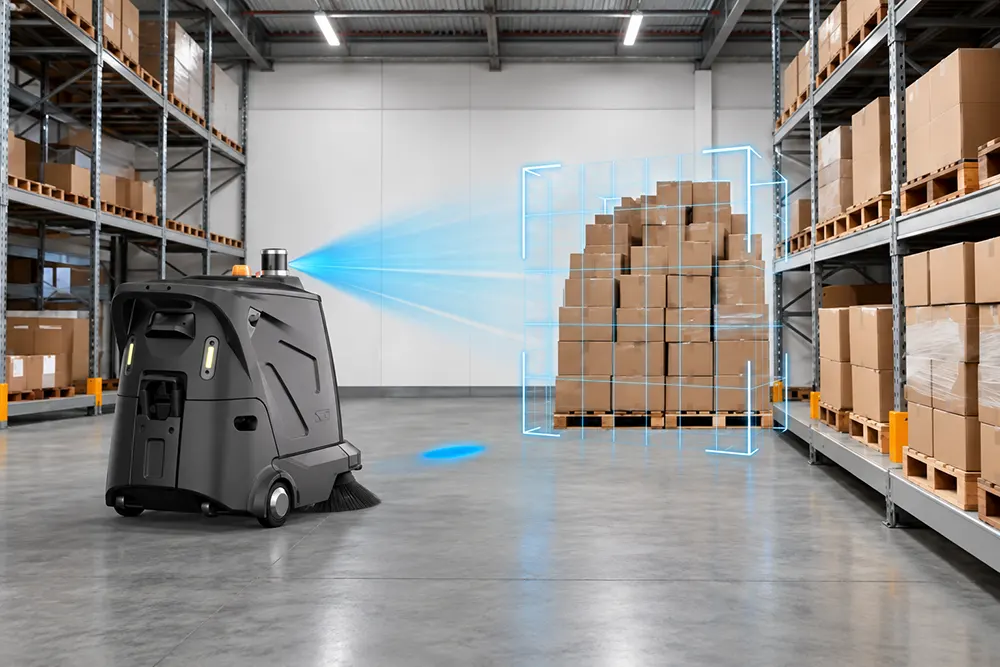
How does an autonomous cleaning robot work? The autonomous cleaning robot combines four connected systems:
- sensors
- artificial intelligence
- movement
- and a cleaning mechanism
Together they allow him to map the space, determine his position, recognize obstacles, plan a route and perform washing, sweeping or vacuuming without the constant control of the operator, while the complete a guide to CenoBots AI cleaning robots gives an overview of the models, their specifications and purpose. Here, the focus is on the technology behind autonomous operation, how the robot sees space, how it knows where it is, how it plans movement and how it reacts to changes during cleaning.
What makes a robot truly autonomous?
The robot is made autonomous by a combination of sensors that collect data about the environment, an AI computer that interprets that data and makes decisions, a movement system that executes the route plan, and a cleaning mechanism that performs the physical task. Without any of these four elements, the robot would depend on constant human management.
In business facilities, this matters because a robot rarely works in an empty, static environment. For example, L3 uses these four systems, among other things, in narrow hospital and school corridors, while S5 applies the same principles in open warehouse aisles shared with forklift traffic. The underlying architecture is the same, but it is adapted to a very different environment.
How does the robot map the space before it starts cleaning?
Before the first autonomous cleaning, the robot uses LiDAR and cameras to scan the object and create a digital map of walls, columns, passages and fixed obstacles. The facility team then defines the cleaning zones, restricted areas and work schedule on that map, giving the robot a basis for all future routes.
How does a robot see the space around it?
The robot "sees" with a combination of 3D LiDAR sensors, depth cameras and, in some models, bumper and IMU (inertial) sensors. LiDAR uses laser pulses to measure distance to objects and build spatial data, while cameras add visual and depth information that LiDAR alone cannot provide.
The number of LiDAR channels and the combination of additional sensors vary from model to model. L3 uses a much denser LiDAR (96 channels) intended for precise navigation in narrow spaces, while the other models use a 32-channel LiDAR with a range of up to 150 meters, supplemented by cameras and additional sensors in models that work in busier areas.
| Model | LiDAR | Additional sensors for perception |
| L3 | 96-channel 3D LiDAR | |
| L4 | 32-channel 3D LiDAR, range 150 m | 3D depth camera, bumper, IMU |
| L50 | 32-channel 3D LiDAR, range 150 m | depth cameras |
| S5 | 32-channel 3D LiDAR, range 150 m | |
| SP50 | 32-channel 3D LiDAR, range 150 m | 3D depth camera, bumper, IMU |
How does the robot know exactly where it is during operation?
Localization is the process by which a robot determines its own position in space using sensor data and a map of the environment. When the system simultaneously determines the position of the robot and builds or updates the map, that process is called SLAM (Simultaneous Localization and Mapping).
How does a robot plan a route to move through an object?
Once it knows where it is, the robot plans a path that covers a given zone with minimal overlap, respects the distance between passages and avoids dead ends. A well-planned route allows for more predictable cleaning than manual work, as the robot follows the same logic each time instead of depending on the habits of the individual operator.
The working width directly affects how quickly the robot covers the space:
- L3 with a working width of 400 mm, it moves in narrow retail aisles
- L4 with 450 mm, it additionally follows the edge of the shelf at a distance of less than 3 cm
- L50 with a working width of 510 mm, it covers larger open areas in fewer passes
How does a robot recognize and avoid obstacles in real time?
The robot combines LiDAR, depth cameras and safety sensors to register on the fly people, carts, pallets or temporary obstacles that were not part of the original map. Depending on the situation, it slows down, stops, or changes course, instead of stopping permanently at the first obstacle.
In some models, this function goes a step further:
- S5 has a special vehicle recognition function (Vehicle Recognition) intended for warehouses and parking lots where forklifts and vehicles move
- models from L-series adapt obstacle processing to the density of people and equipment typical of retail and healthcare facilities
How does an AI system "understand" what the robot sees?
In addition to basic obstacle detection, the AI system processes the data the robot receives from LiDAR, cameras and other sensors to distinguish situations in the environment and adjust its movement. With some CenoBots model more advanced AI models are used for more complex data interpretation and work in a changing space.
Practically, such a system helps the robot to distinguish a person temporarily passing by from a permanent obstacle that requires a change of route, as well as to recognize the type of dirt and prioritize the zones that are really dirty.
| Model | AI platform |
| L3 | NVIDIA AI chip, 100 TOPS |
| L4 | NVIDIA AI chip, 32 TOPS |
| L50 | NVIDIA AI chip, 32 TOPS, ~10 billion parameters ("big model") |
| S5 | NVIDIA AI chip, 100 TOPS |
| SP50 | NVIDIA AI chip, 32 TOPS |
How does a robot physically clean the floor?
The cleaning method depends on the type of robot:
- models for washing and drying floors they dose the solution, brush the floor and vacuum the dirty water into a separate tank
- sweeping robot collects dry waste in a basket with brushes
- vacuum cleaner robot and local cleaning targets visible dirt on hard floors and carpets.
| Model | Type of cleaning | Key components | Working width |
| L3 | Washing and drying | Solution tank 25 L, brushes, squeegee, suction of dirty water | 400 mm |
| L4 | Washing and drying | Solution tank 38 L, edge-cleaning brushes (up to 3 cm from the wall) | 450 mm |
| L50 | Washing and drying | 55 L solution tank, 5-stage filtration and water recirculation | 510 mm |
| S5 | Dry sweeping | Side and main brushes, waste basket 50 L, HEPA filtration | 820 mm |
| SP50 | Vacuuming and local cleaning | Dust bag 18 L + waste bin 5 L, CRC technology (re-treatment of the same zone until a satisfactory result) | 720 mm (with side brushes) |
How does the robot charge and continue working throughout the day?
The robot monitors the battery level and, when it reaches a defined threshold, autonomously stops cleaning and returns to the charging station using the saved map and current position. With floor washing robots, individual stations additionally automatically refill water and empty the waste tank, which reduces the need for manual servicing.
The difference between the models is most noticeable right here: L3 uses a dedicated WS3 station (with optional WT3 mobile tank for facilities without an accessible water connection), L4 and L50 can use the optional 4-in-1 workstation, while S5, as a dry robot, does not require water refilling and only returns to the battery charging station.
| Model | Battery | Charging time | Autonomy of work | Station type |
| L3 | LFP 60 Ah | 1.5-2 hours | until 4 p.m | WS3 (filling + water + detergent), optional WT3 mobile tank |
| L4 | LFP 70 Ah | 2.7 h | up to 4.5 h | optional 4-in-1 station (filling + water + detergent) |
| L50 | 120 Ah | not publicly stated | until 6 a.m | 4-in-1 station (filling + water + detergent) |
| S5 | LFP 75 Ah | 2 h (quick charge) | 5-7 h | charging station (without water refill) |
| SP50 | LFP 120 Ah | 4 h | 13 h (spot-cleaning) / 8 h (regular mode) | charging station |
You can read more about charging and battery life on the blog: Battery and charging of the cleaning robot
Why is this important when choosing a robot for a facility?
Understanding how a robot sees, understands and cleans a space helps facility managers ask specific questions instead of just relying on marketing claims. The question, therefore, is not only "which robot has a stronger sensor", but which complete system: sensors, AI, movement and cleaning mechanism together, is suitable for the specific space and task.
How does an autonomous cleaning robot work? - FAQ
Does the robot have to remap the entire space every time something changes?
Not completely. The base map remains the same, while continuous scanning allows the robot to register temporary changes, a moved chair, a new pallet or an occupied aisle and adjust the movement without the need for a complete remapping.
Do all models charge the same way?
No. As a rule, floor washing robots (L3, L4, L50) use stations that, in addition to charging the battery, automatically refill the water, while the dry sweeping robot (S5) and vacuuming robot (SP50) only require battery charging, without refilling the water.
Technology is just the beginning. The right choice depends on the space, task and way of working. Let's look together how CenoBots can fit into your facility.
About the author:
Milja Tonić – SEO Content Strategist & Copywriter
Milja Tonić is an SEO Content Strategist and Copywriter, specializing in the creation of expert content in the field of facility management, professional maintenance of business facilities and automation of cleaning processes.
Through research, SEO strategy and authoring, he develops content on professional hygiene, facility management and the application of autonomous cleaning robots in various business environments.