
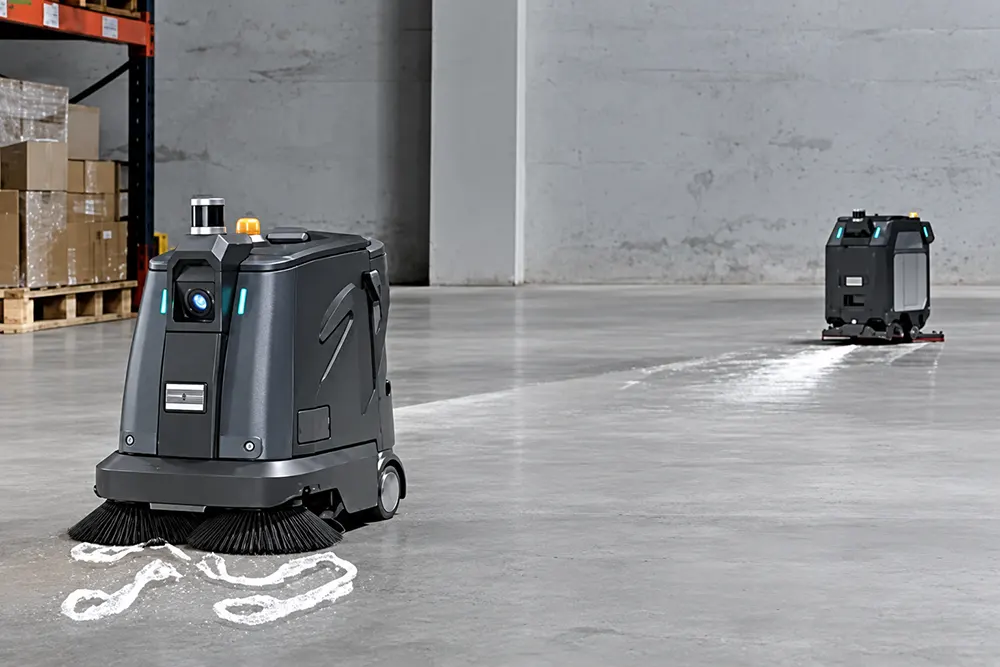
How can multiple CenoBots robots work in the same facility? More CenoBots robot can work in the same facility when their zones, tasks and mode of operation are pre-aligned with the space. Multiple units of the same model can increase the cleaning capacity of a large area. While different models can take on different stages of floor maintenance, according to their purpose.
Not every facility needs such an approach. Its value becomes more pronounced in large warehouses, factories, shopping centers and other areas where one robot cannot cover all zones in the available time or where floor maintenance requires several different tasks.
With the S5 model, the manufacturer mentions the TeamClean function for the operation of several units as a fleet. While different models can be used for different types of tasks within the same facility.
In order for multiple units to be able to fit into the organization of cleaning one facility, it is important to understand how an autonomous cleaning robot works, from mapping space and defining zones to planning routes and reacting to obstacles.
When does it make sense to use multiple robots in the same facility?
Multiple robots make sense when the size of the space, the amount of work or the available time exceeds the capacity of a single unit, but also when the facility requires different types of cleaning. Before making a decision, you should evaluate the area, the layout of the zones, the type of dirt, the floor covering, the frequency of cleaning and the time in which the tasks must be completed.
How do multiple S5 robots work as a fleet?
CenoBots TeamClean allows multiple S5 units to work collaboratively as a fleet, improving cleaning coverage in large warehouses and factories. Instead of one unit handling a large area on its own, several S5 robots can contribute to the cleaning task, which is especially useful when the workload is high.
It is important, however, to distinguish TeamClean from the simple presence of multiple robots in a facility. CenoBots explicitly describes this feature for multiple S5 units. Therefore, it should not be automatically attributed to every combination of different CenoBots models.
Can different CenoBots models work in the same facility?
Yes, different CenoBots models can be part of the same maintenance plan when a facility requires different types of cleaning. The key is to divide the tasks according to the function of the particular robot: one model can remove loose dirt. While the scrubber-dryer model takes over the washing of a suitable hard floor surface.
For example, S5 + L3 they can have different roles. The S5 is intended for sweeping and waste collection, while the L3 washes hard floors and has a working width of 400 mm. Due to its compact dimensions and minimum passage width of 700 mm, L3 is also intended for spaces with narrow passageways.
For larger areas, a different combination can be considered. The L50 has a working width of 510 mm, a solution tank of 55 liters and a declared maximum theoretical productivity of 2,203 m²/h, so it is positioned for more demanding tasks of washing larger surfaces.
Can one robot clean after another has finished?
Cleaning can be organized in stages so that different robots perform successive tasks, but it should not be assumed that the second model is automatically activated when the first one is finished. The order of work should be defined through the cleaning plan and the capabilities of the specific system, especially when combining different CenoBots models.
Can multiple robots work simultaneously in the same space?
Several robots can be engaged in the same facility, but simultaneous work should be planned according to the size and layout of the space, defined zones and routes, as well as the presence of people, vehicles and other obstacles. The way of organization depends on the model and specific configuration of the system in the facility.
The safety of autonomous systems depends not only on the characteristics of the devices but also on the conditions in the space in which they move. ISO 3691-4, which governs safety requirements for driverless industrial vehicles and their systems, as part of safe operation also considers operational zone conditions.
How do you choose the models that will work in the same facility?
Models are chosen according to specific tasks, and not only according to the size of the object. It is necessary to determine whether the priority is sweeping, vacuuming or washing, what the floor surface is like, how wide the aisles are and how much surface should be processed in the available time. Only then is the appropriate combination of robots determined.
The CenoBots portfolio enables different roles:
- S5: autonomous sweeping and collection of dust and loose waste; the manufacturer also confirms TeamClean for this model.
- SP50 : autonomous vacuuming and sweeping, with AI Spot Cleaning, intended for hard floors and carpets.
- L3: a compact scrubber-dryer for washing hard floors, also suitable for narrow aisles.
- L4: scrubber-dryer with a working width of 450 mm and cleaning close to the edge of the wall.
- L50: larger capacity scrubber-dryer, with a working width of 510 mm and a solution tank of 55 liters.
Therefore, the fleet does not have to consist of identical robots. It is more important that each model solves a clearly defined part of the process.
What conditions should the facility meet for the operation of multiple robots?
The facility should have enough space for safe movement, clearly defined zones and tasks, suitable floor surfaces and organized filling and maintenance logistics. With the scrubber-dryer model, clean and dirty water management should also be planned. While with a larger number of robots, the work schedule and availability of stations should be coordinated.
The physical layout of the building is one of the first criteria. For example, L3 has a minimum aisle width of 700 mm, while L4 requires at least 810 mm. Therefore, a robot suitable for a large open hall may not be the best choice for every corridor or narrow area.
The service infrastructure should also be planned. The S5 automatically returns to its station when the battery is low, charges and, according to the manufacturer, resumes the previous task. L3 can use a WS3 workstation that automates filling, refilling of clean water, emptying of dirty water and refilling of detergent.
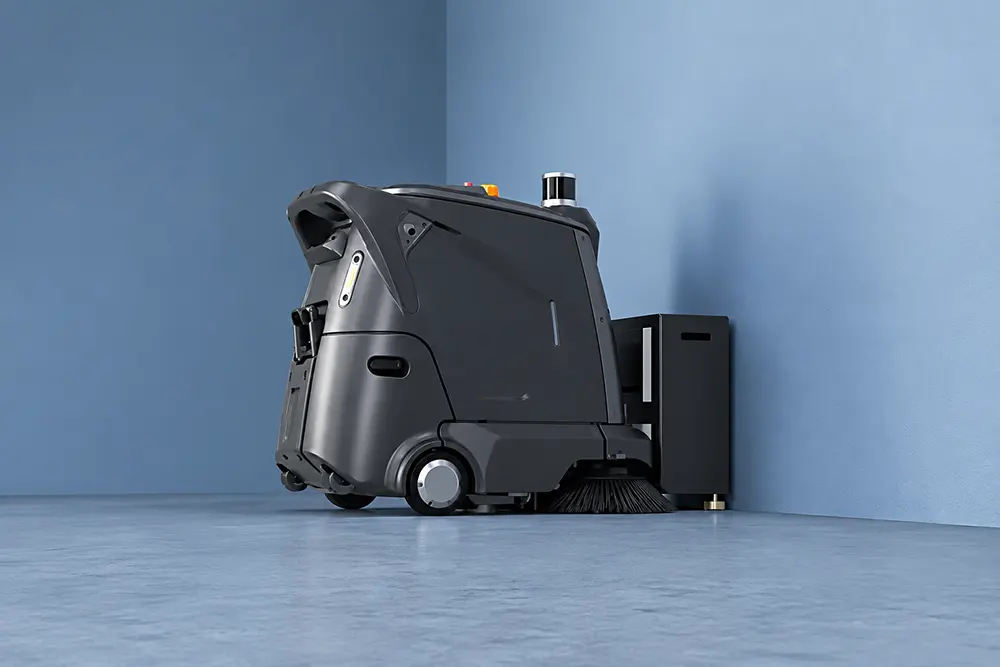
How can multiple CenoBots robots work in the same facility? - FAQ
Does every robot have to have its own charging station?
It depends on the model and type of station used. CenoBots has different charging solutions and workstations dedicated to specific models. When several robots are planned in one facility, it is necessary to check in advance the compatibility of the stations and their number so that charging is coordinated with the planned work schedule.
Can the number of robots subsequently increase if the facility is expanded?
The number of robots can be increased as the needs of the facility grow, but each new unit should fit into the existing cleaning plan and infrastructure. Expansion of the area may require a new division of zones, a different arrangement of tasks or additional capacities for filling and maintenance, so before the expansion it is necessary to re-evaluate the organization of the system.
Do all robots have to work on the same cleaning schedule?
No. The layout can be adapted to the function of the robot and the needs of individual zones. For example, the frequency of sweeping does not have to be the same as the frequency of washing the floor. In facilities with different load levels, tasks can be organized accordingly where, when and what type of cleaning is required, instead of one schedule for the entire fleet.
Each space requires a different system. Let's find one that fits yours.
About the author:
Milja Tonić – SEO Content Strategist & Copywriter
Milja Tonić is an SEO Content Strategist and Copywriter, specializing in the creation of expert content in the field of facility management, professional maintenance of business facilities and automation of cleaning processes.
Through research, SEO strategy and authoring, he develops content on professional hygiene, facility management and the application of autonomous cleaning robots in various business environments.