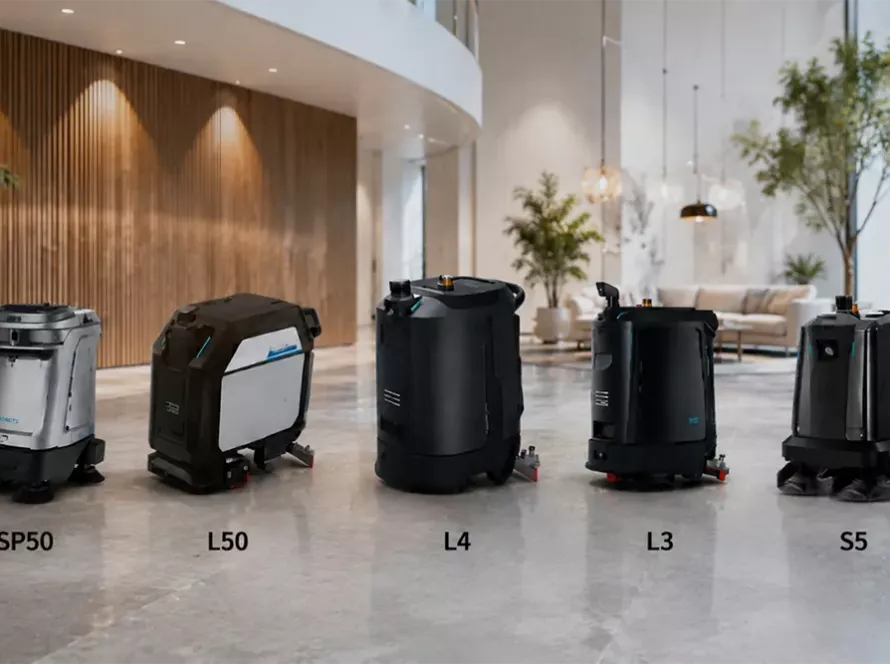
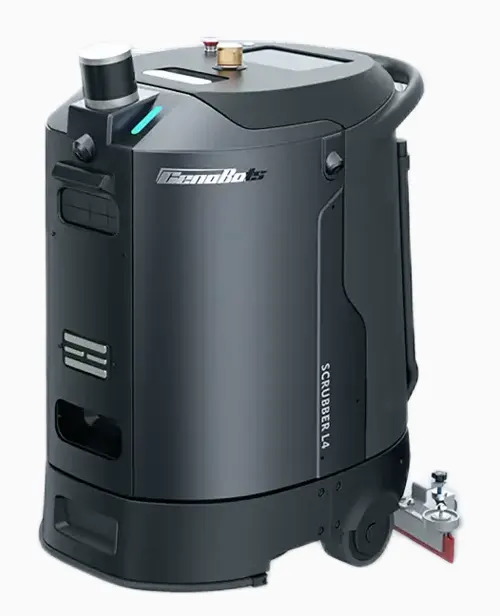
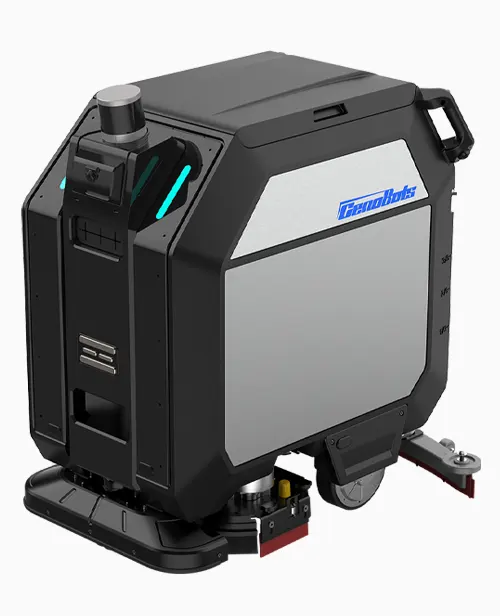
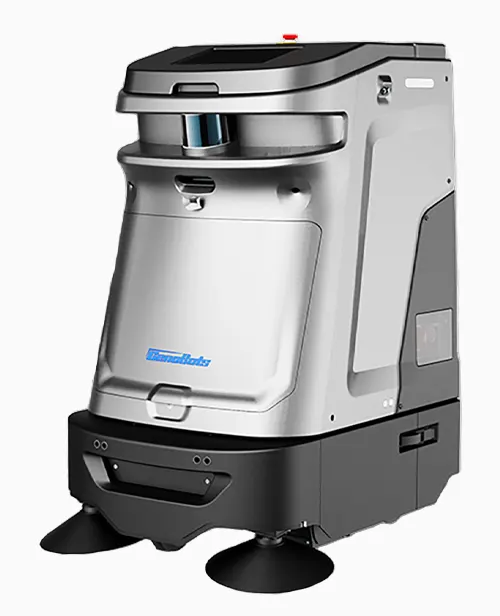


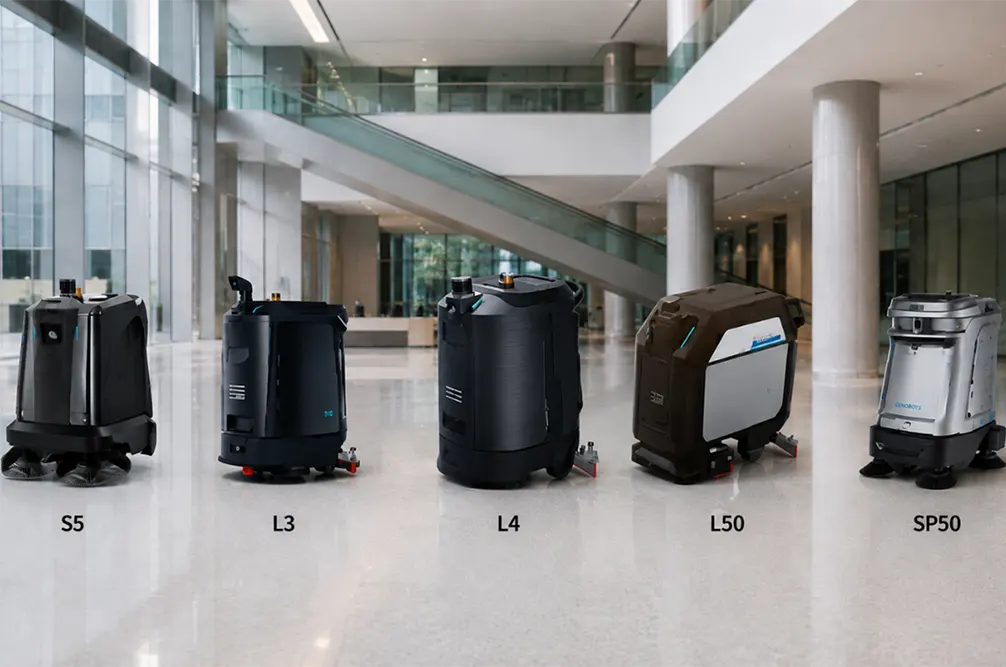
CenoBots AI cleaning robots include five models designed for different tasks:
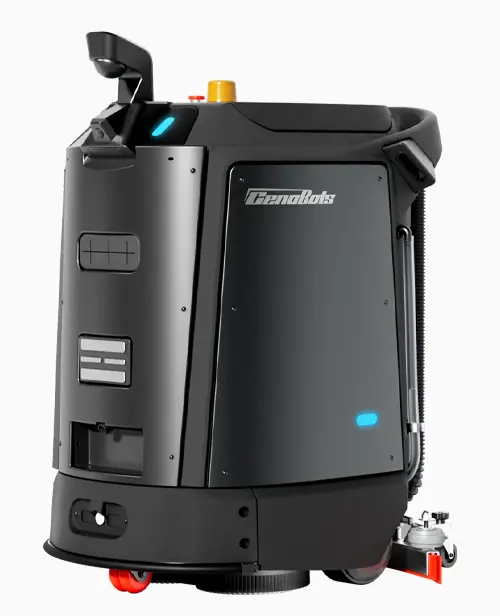
- L3, L4 and L50 wash and dry hard floors
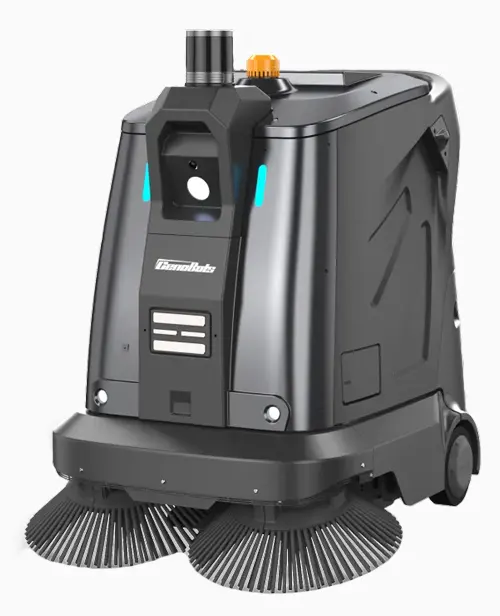
- S5 collects dry waste
- SP50 vacuums and uses AI Spot Cleaning to remove dirt from targeted areas
The right model therefore depends on the facility, floor, type of dirt and operating requirements.
No single CenoBots robot is the best choice for every commercial space. In a hospital corridor, compact dimensions, precise movement and safe operation around people are important. In a logistics centre, large capacity and dry waste removal may take priority, while a shopping centre may require both hard-floor washing and targeted waste removal during operating hours.
What are CenoBots AI cleaning robots?
CenoBots AI robots for cleaning are autonomous professional machines designed to maintain commercial and industrial facilities. They combine washing, vacuuming or sweeping systems with 3D LiDAR, cameras, sensors and AI navigation, enabling them to map spaces, plan routes, detect obstacles and perform cleaning tasks independently.
Unlike household robotic vacuum cleaners, CenoBots robots are designed to work across larger areas, under more demanding conditions and according to predefined tasks. Depending on the model and its intended use, they can perform different types of cleaning and adapt to the facility’s characteristics.
Their key difference from conventional cleaning machines involves more than simply moving without an operator.
To operate autonomously, the robot must determine the following during a task:
- Where is it?
- Which route should it follow?
- What lies in its path?
- How should it respond when conditions in the space change?
For this reason, a modern professional robot combines a mechanical cleaning system with autonomous navigation. CenoBots equips its commercial scrubber models with 3D LiDAR, depth cameras, sensors and AI computing systems to map spaces, plan safe routes and avoid obstacles.
This system allows the robot to repeat predefined tasks and independently clean the surfaces for which it is designed, while employees focus on work that cannot be practically automated. This includes cleaning stairs, toilets and hard-to-reach surfaces, as well as handling tasks that require human judgement.
How does the robot know where to go?
Using 3D LiDAR, cameras and other sensors, a CenoBots robot creates a digital map of the space and determines its position within it. The navigation system then plans a route through the designated zones, tracks which sections it has already covered and organises subsequent passes to cover the planned area systematically with minimal overlap.
How does the robot respond to people and obstacles while cleaning?
People, trolleys and vehicles can suddenly alter conditions along the planned route, so the robot continuously monitors its surroundings and responds to new obstacles. The navigation system can slow the robot down, stop it or change its route. L3 uses 96-channel 3D LiDAR, while S5, equipped with 32-channel LiDAR, also supports vehicle detection in dynamic environments.
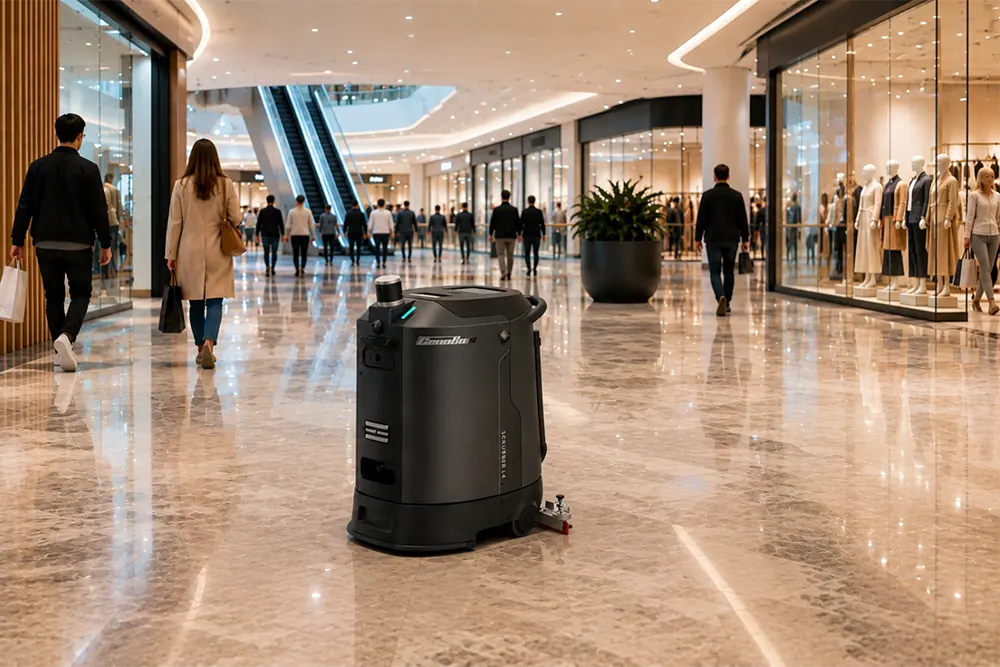
What is the difference between CenoBots L3, L4, L50, S5 and SP50?
L3, L4 and L50 belong to the same group of floor-washing and drying robots, but they suit different space sizes and layouts.
S5 performs a different task: sweeping and collecting dry waste, while SP50 handles vacuuming and AI Spot Cleaning on hard floors and commercial carpets.
| Model | Type of cleaning | Working width | Capacity | Key advantage | Most suitable facilities |
| L3 | Floor washing and drying | 400 mm | 25 L of clean water | Compact dimensions, precise navigation and movement through challenging areas | Hospitals, schools, offices, hotels, shops |
| L4 | Floor washing and drying | 450 mm | 38 L of clean water | Cleaning within less than 3 cm of walls and a good balance between capacity and manoeuvrability | Shopping centres, retail spaces, corridors, healthcare facilities |
| L50 | Floor washing and drying | 510 mm | 55 L of clean water | Greater capacity and productivity of up to 2,203 m²/h | Warehouses, logistics centres, factories, large retail facilities |
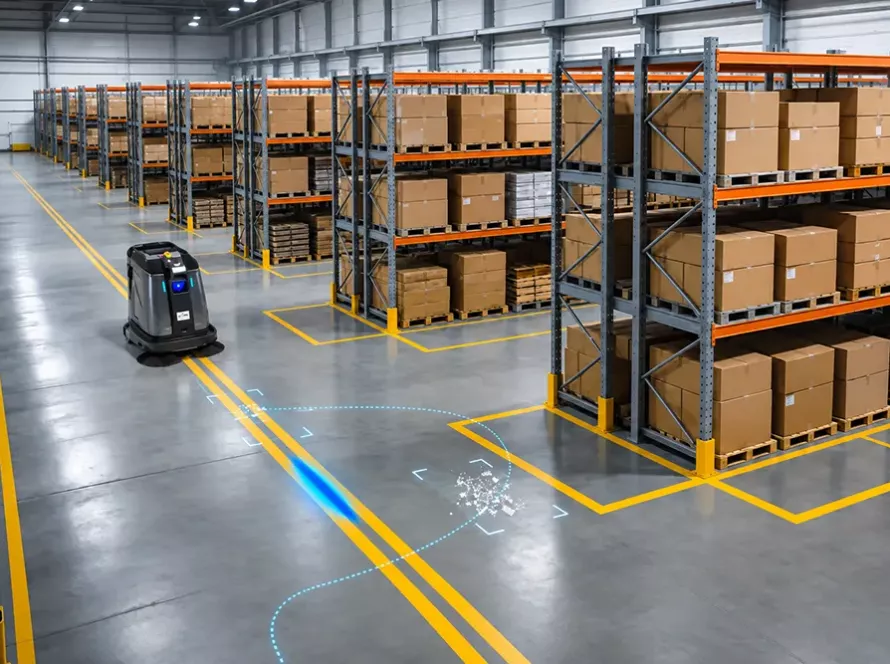
| S5 | Sweeping and collecting dry waste | 820 mm | 50 L waste capacity | Large working width and productivity of approximately 2,500 m²/h | Factories, warehouses, logistics facilities, garages |
| SP50 | Vacuuming and AI Spot Cleaning | Detecting and targeting localised dirt | Airports, shopping centres, hotels, hospitals, office buildings |
Which robot is right for your facility?
The right CenoBots model depends on the surface area, floor type, passage width, type of dirt, foot traffic and required level of autonomy. L3 suits more compact spaces, L4 suits medium-sized facilities and cleaning along edges, L50 handles large hard-floor areas, S5 removes dry waste, while SP50 handles vacuuming and the targeted treatment of localised dirt.
| If your facility has… | Model | Why choose this model? |
| Hard floors, narrow passages and limited manoeuvring space | L3 | Its compact dimensions and autonomous washing and drying make it suitable for complex layouts and busy indoor spaces. |
| Medium-sized areas and numerous edges along walls, shelves or equipment | L4 | It combines washing and drying with edge cleaning, making it suitable for commercial spaces with numerous fixed elements. |
| Large open areas with hard floors | L50 | Its greater capacity, working width and longer operating time suit the cleaning of large commercial and industrial areas. |
| Dust, cardboard and small or large pieces of dry waste | S5 | It performs autonomous sweeping and dry waste collection, particularly in warehouses, factories and logistics facilities. |
| Hard floors and commercial carpets, or a need for targeted removal of localised waste | SP50 | It vacuums and uses AI Spot Cleaning to detect and target areas where waste has appeared. |
Which CenoBots robots can work together in the same facility?
CenoBots robots can work together when a facility has different surface types or requires several cleaning methods. L3, L4 or L50 can wash and dry hard floors, while S5 can handle dry waste and SP50 can perform vacuuming and targeted AI Spot Cleaning.
| Model combination | Division of tasks | Suitable for |
| L3 and SP50 | Washing and drying, vacuuming and Spot Cleaning | Hotels, hospitals, office buildings |
| L4 and SP50 | Washing hard floors and edge areas, vacuuming and Spot Cleaning | Shopping centres, airports, larger retail facilities |
| L50 and S5 | Washing large areas, sweeping and collecting dry waste | Warehouses, factories, logistics centres |
| L50 + SP50 | Regular washing of large areas and targeted removal of localised dirt | Airports, large commercial facilities |
Does an AI cleaning robot replace employees?
An AI cleaning robot does not replace employees; it takes over repetitive floor-cleaning tasks. Facilities still need employees to clean toilets, stairs, hard-to-reach areas and above-floor surfaces, and to perform tasks that require human judgement. Automation therefore enables a different allocation of work: the robot performs planned routine tasks, while staff focus on more complex work and other facility maintenance priorities.
According to the European Agency for Safety and Health at Work (EU-OSHA), advanced robotics and AI systems can automate repetitive physical tasks, while their implementation affects work organisation and the way employees interact with technology.
What does introducing a robot into a facility involve?
Introducing a robot begins with an analysis of the space and the tasks to automate. After selecting the appropriate model, the implementation team creates a map of the facility, defines cleaning zones, restricted areas and planned routes, configures the operating mode and checks the robot’s behaviour under real-world conditions before regular use begins.
How can you monitor the robot’s work and cleaning results?
A professional robot’s work does not end when it starts following its designated route. CenoBots systems enable digital performance monitoring, including data on completed tasks, cleaned areas, operating time and route coverage, while management tools allow users to monitor status and organise the work of multiple robots.
These data allow the responsible person to verify task completion without physically following the robot throughout the entire cycle. This proves particularly useful in large facilities and systems where multiple robots operate in different zones.
What happens when the robot completes a task?
After the robot completes the planned cleaning cycle, the next step depends on the model, settings and system configuration. With compatible models, charging stations and workstations can handle some routine operations between cleaning cycles, reducing the need for manual staff intervention.
For example, when paired with the WS3 workstation, L3 supports automatic charging, clean-water refilling, wastewater drainage and detergent refilling. S5 supports automatic return to its charging station, enabling a higher level of autonomy during operation.
What can a CenoBots robot not clean?
CenoBots robots automate specific floor-maintenance tasks, but they cannot replace every type of professional cleaning. Staff must still clean stairs, toilets, furniture, vertical and other above-floor surfaces and hard-to-reach areas, as well as perform specific tasks that require manual work.
CenoBots AI cleaning robots – FAQ
Does the robot have to map the space again before every task?
No. The robot can use the map created during implementation for subsequent tasks while monitoring its surroundings and responding to changes during operation. The operator can define cleaning zones, restricted areas and preferred routes within the mapped space, so the robot does not need to repeat the entire initial mapping process before every task.
What happens if the facility layout changes after mapping?
The robot detects temporary changes, such as people, trolleys or relocated equipment, with its sensors during operation and adapts its movement to current conditions. Significant layout changes may require adjustments to the map, zones or designated routes so that the cleaning plan reflects the new spatial arrangement.
Can a CenoBots robot operate while people are in the facility?
Yes, CenoBots robots are also designed for dynamic commercial spaces where people and other equipment move around. LiDAR, cameras and other sensors monitor the surroundings during operation, allowing the robot to detect obstacles and adjust its movement—an important capability in hospitals, shops, hotels and other busy facilities.
Does a CenoBots robot require a workstation?
No. A CenoBots robot does not require an automated workstation for every mode of operation, but compatible models can use one to achieve a higher level of autonomy.
Do the robots require maintenance?
Yes. Autonomous operation does not eliminate the need for regular maintenance. Brushes, suction components, filters, tanks and other parts that come into contact with water or dirt require regular inspection and maintenance. CenoBots uses modular and quick-release components in certain models to simplify routine maintenance.
Choosing a robot involves more than comparing models and technical specifications. The right solution depends on the space where the robot will operate, the types of flooring, traffic levels, cleaning schedule and tasks you want to automate. If you would like us to review these requirements with you and assess which CenoBots model best suits your facility, we can begin with a brief analysis of your needs.
About the author:
Milja Tonić SEO Content Strategist & Copywriter
Milja Tonić is an SEO Content Strategist and Copywriter who specialises in creating expert content on facility management, professional maintenance of commercial facilities and the automation of cleaning processes.
Through research, SEO strategy and original content development, she produces content about professional hygiene, facility management and the use of autonomous cleaning robots in various commercial environments.