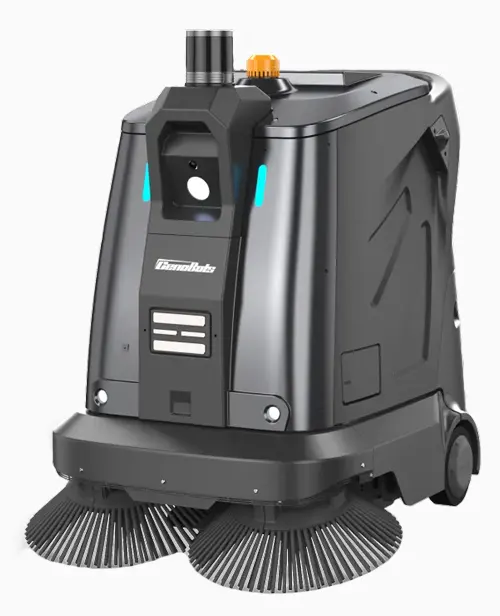
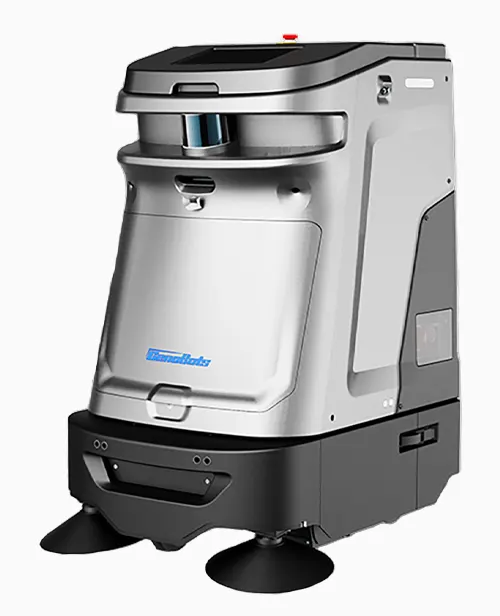


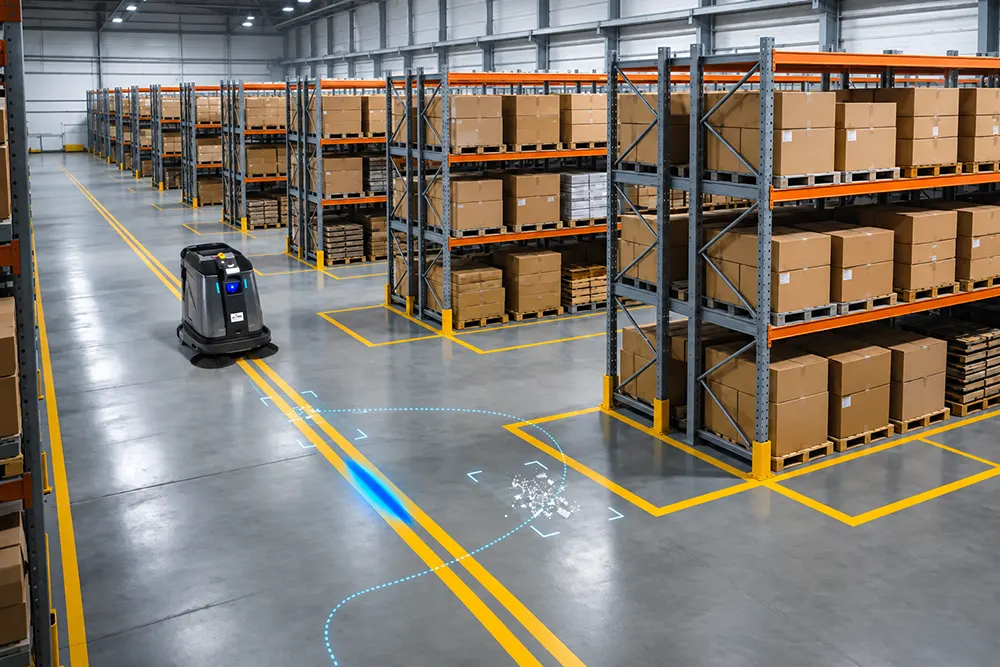
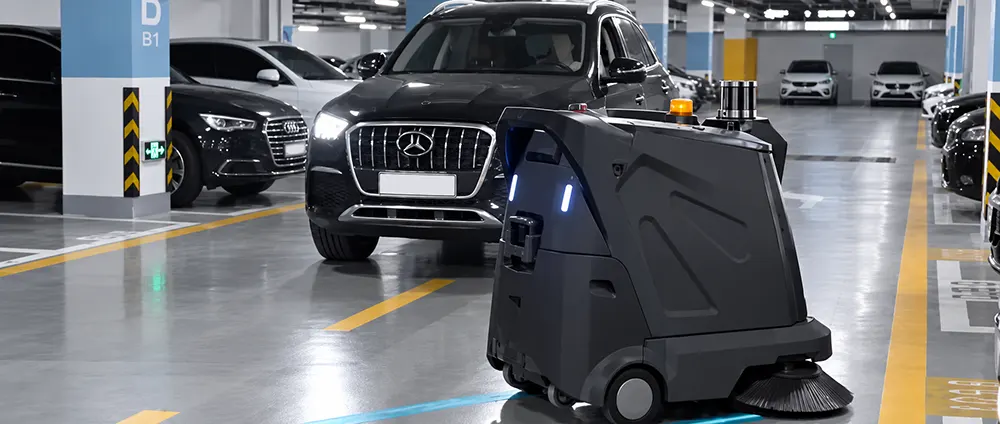
How does a sweeping robot clean large areas? CenoBots S5 is an autonomous robot designed for dry sweeping of large commercial and industrial areas. With a sweeping width of 820 mm, a 50-litre waste container, and a maximum theoretical cleaning capacity of around 2,500 m²/h, it removes dust and loose debris in facilities such as warehouses and factories.
S5 does not wash floors with water. Its task is to collect dry debris, including:
- fine dust
- paper
- plastic bottles and bags
- packaging film
- wood debris
- and small metal debris
S5 is one of five CenoBots models designed for different professional maintenance tasks. If you want to compare its purpose with robots for washing, drying, and vacuuming, read our guide: CenoBots cleaning robot models, which provides an overview of specifications and application areas.
How does S5 know where to move?
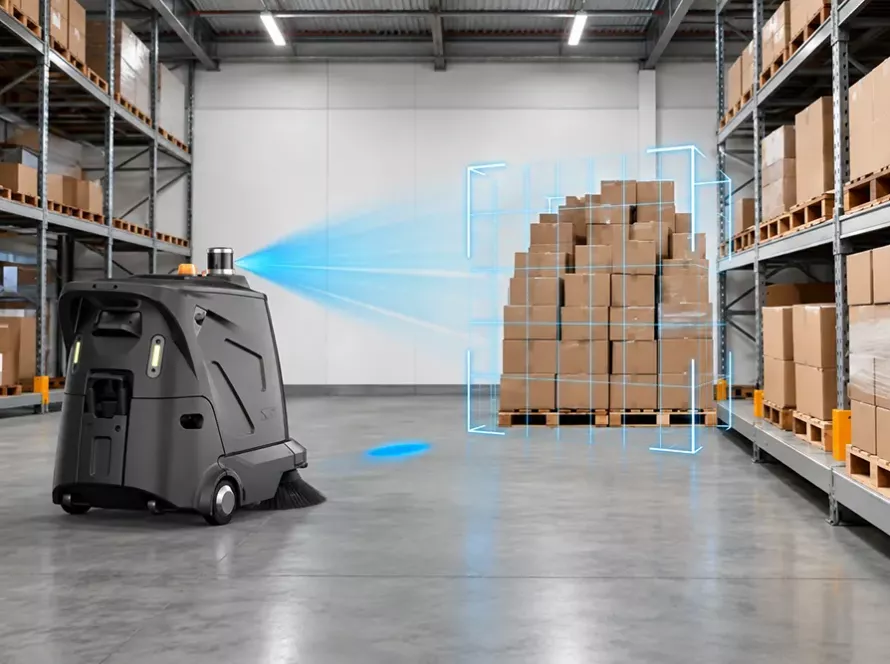
S5 uses a 32-channel 3D LiDAR with a specified detection range of up to 150 metres and a 100 TOPS NVIDIA AI platform. The system enables the robot to map spaces, determine its position, and move autonomously through industrial areas containing racks, pallets, equipment, people, and vehicles.
The Dynamic Environment Adaptation function allows the robot to adjust its route and behaviour to changes in the environment. This is especially important in warehouses and factories, where obstacle layouts do not always remain the same.
How does S5 react to forklifts and other vehicles?
S5 uses the Vehicle Recognition function to identify forklifts, AGVs, and other vehicles in the working area. By combining its AI system with 3D LiDAR perception, the robot detects and avoids them, allowing it to move autonomously in dynamic industrial environments where traffic continues during cleaning.
However, this does not mean that planning is unnecessary. You should coordinate the robot’s working zones and routes with the organisation and safety rules of the specific facility.
How does S5 prevent dust from spreading again?
S5 features an Advanced Dust Control system that combines suction and filtration to collect fine dust and other dry debris more efficiently. This is especially useful in factories, warehouses, and garages, where sweeping should not simply move dirt across the floor but collect it while controlling dust.
In its industrial guide, CenoBots also specifies HEPA filtration and an automatic filter cleaning system, which is important for areas where fine dust forms continuously.
What does S5 do when only one part of the area is heavily soiled?
The Spot Cleaning function allows the S5 robot to focus on localised areas with higher amounts of dirt. Instead of repeating a complete cleaning cycle across the entire surface, the robot can concentrate on problem areas, which is useful around goods receiving points, loading zones, entrances, and other places where debris appears more frequently.
This way, the robot does not need to treat the entire large area in the same way.
Can multiple S5 robots clean a large area together?
Yes. TeamClean allows S5 to operate as part of a coordinated cleaning system for large areas. S5 can remove dust and loose debris, while a CenoBots washing robot, such as L50, can then wash and dry the hard floor surface. This allows different maintenance stages to work together as one organised process.
Where does S5 make the most sense?
S5 is designed for large areas where dust and loose dry debris regularly appear. CenoBots recommends it for warehouses, logistics centres, factories, large retail facilities, and parking garages, where wide aisles, large floor areas, and repetitive sweeping create good conditions for autonomous operation.
Before choosing a model, you should therefore assess the type of debris, floor area, aisle width, equipment layout, and traffic intensity rather than focusing only on the robot’s stated cleaning capacity.
| S5 feature | Specification | Importance for large areas |
| Sweeping width | 820 mm | Wider coverage in a single pass |
| Max. theoretical cleaning capacity | around 2,500 m²/h | Faster cleaning of large zones |
| Waste container | 50 L | Fewer interruptions for emptying |
| 3D LiDAR | 32 channels, range up to 150 m | Mapping and autonomous navigation |
| AI platform | NVIDIA, 100 TOPS | Real-time data processing and decision-making |
| Fast charging | around 2 h | Shorter break between cycles |
| Spot Cleaning | Yes | Targeted cleaning of soiled zones |
| Vehicle Recognition | Yes | Vehicle detection and avoidance |
| TeamClean | Yes | Coordinated operation of multiple robots |
| Advanced Dust Control | Yes | Suction and filtration of fine dust |
CenoBots S5: How does a sweeping robot clean large areas? – FAQ
Does S5 wash floors?
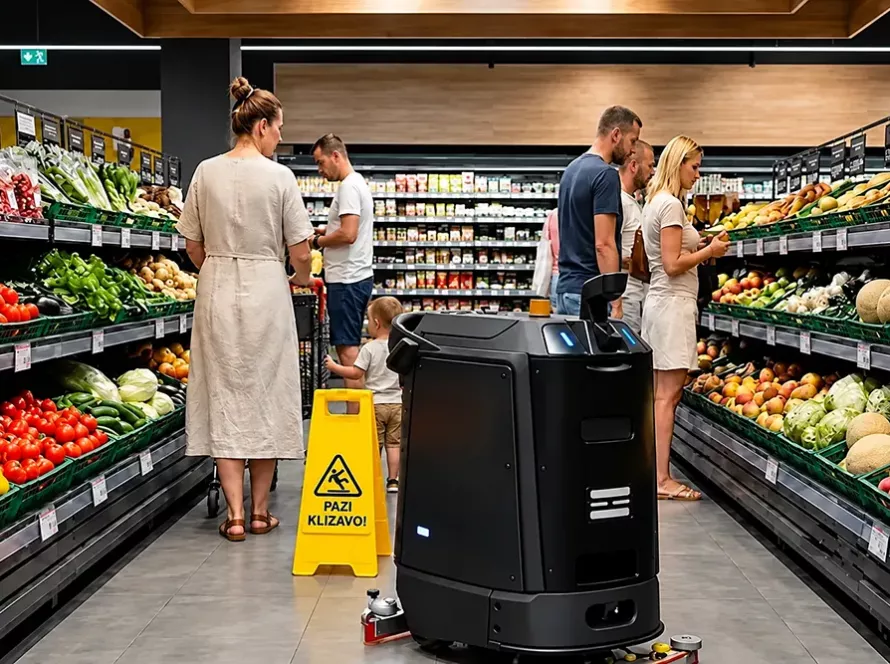
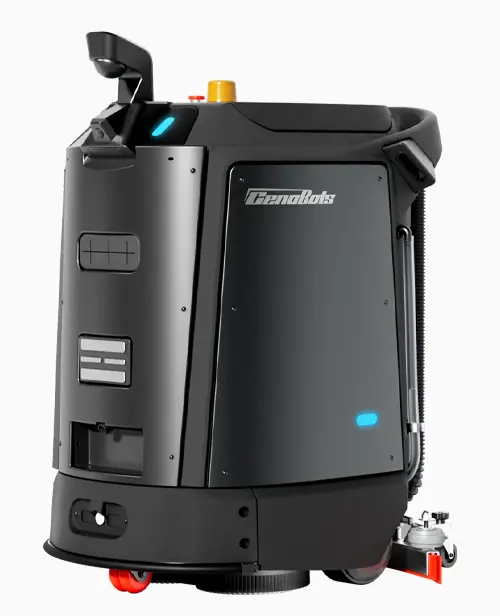
No. S5 is designed for dry sweeping and debris collection. When the floor requires wet washing and drying after sweeping, you can use the CenoBots L3, L4, or L50 models.
Can S5 completely replace manual cleaning?
No. S5 can handle repetitive sweeping of accessible floor areas, while staff remain necessary for hard-to-reach places, robot maintenance, and other tasks that the machine cannot perform.
How does CenoBots S5 charge during autonomous operation?
S5 uses a compatible CS5 station for automatic charging. When the battery level becomes low, the robot independently travels to the station and starts charging without requiring staff to connect it manually. After recharging the battery, it can resume the task it previously started, allowing longer autonomous cleaning cycles across large areas. S5 offers fast charging of approximately two hours.
Large areas. Less repetition. Smarter cleaning.
S5 handles routine sweeping of large floor areas, while your team stays focused where it is truly needed.
See how S5 would work in your facility.
About the author:
Milja Tonić – SEO Content Strategist & Copywriter
Milja Tonić is an SEO Content Strategist and Copywriter who specialises in creating expert content in the fields of facility management, professional maintenance of commercial facilities, and cleaning process automation.
Through research, SEO strategy, and original content development, she creates content about professional hygiene, facility management, and the use of autonomous cleaning robots in different business environments.