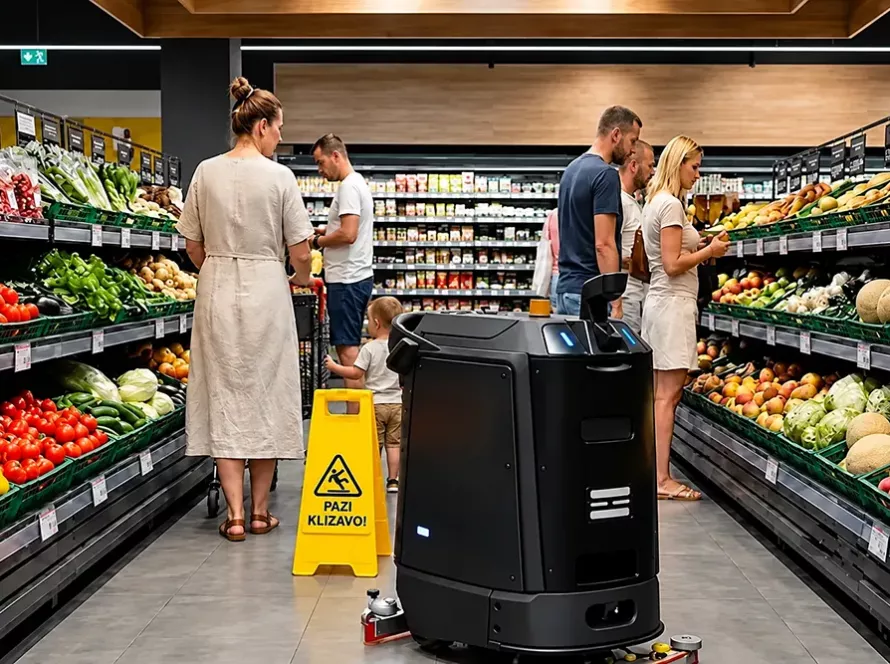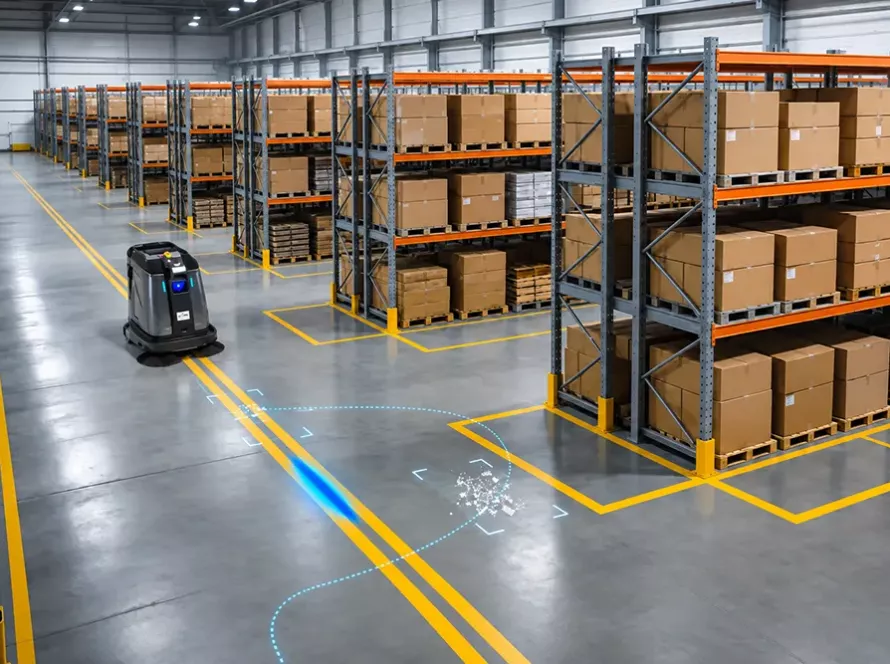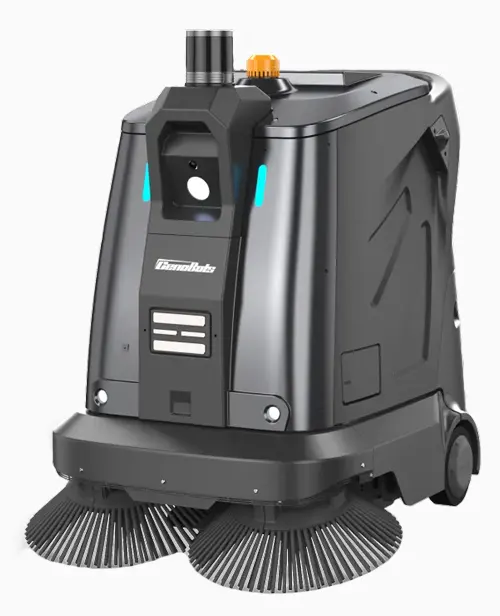
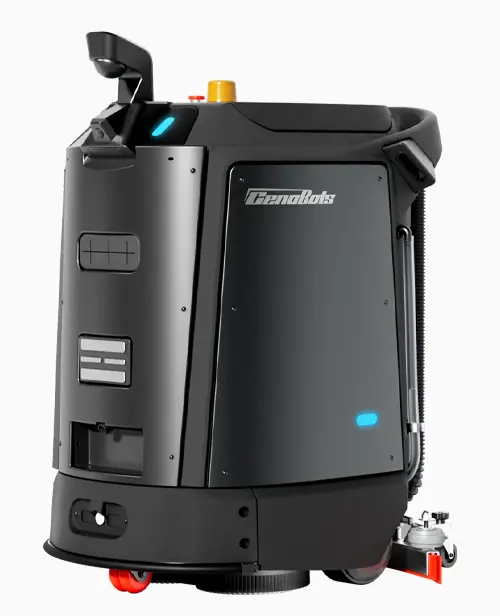
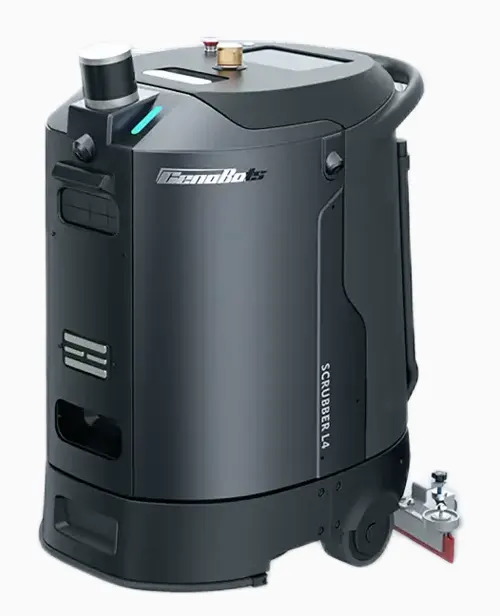
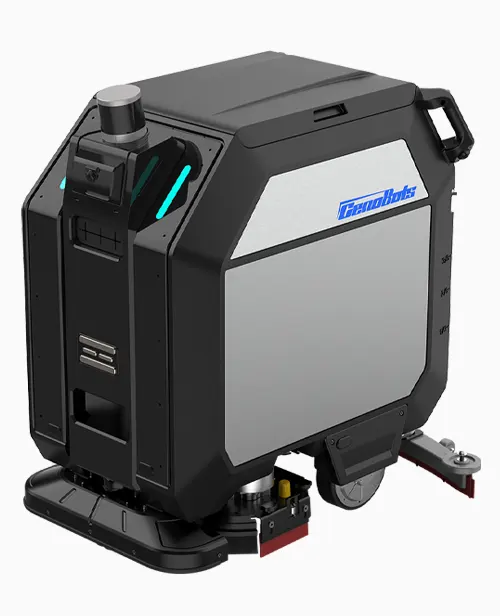


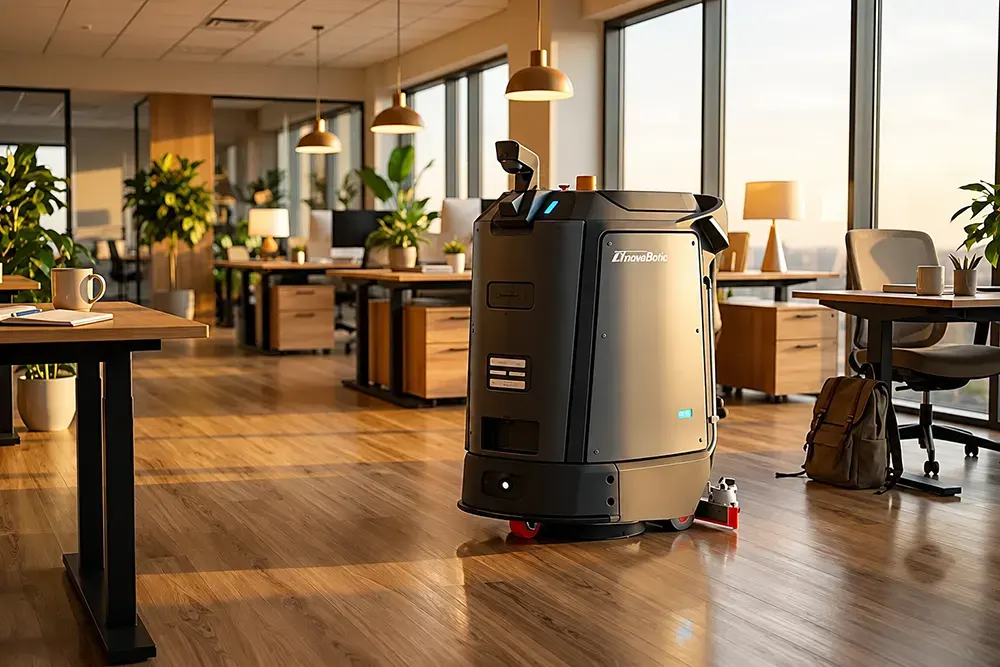
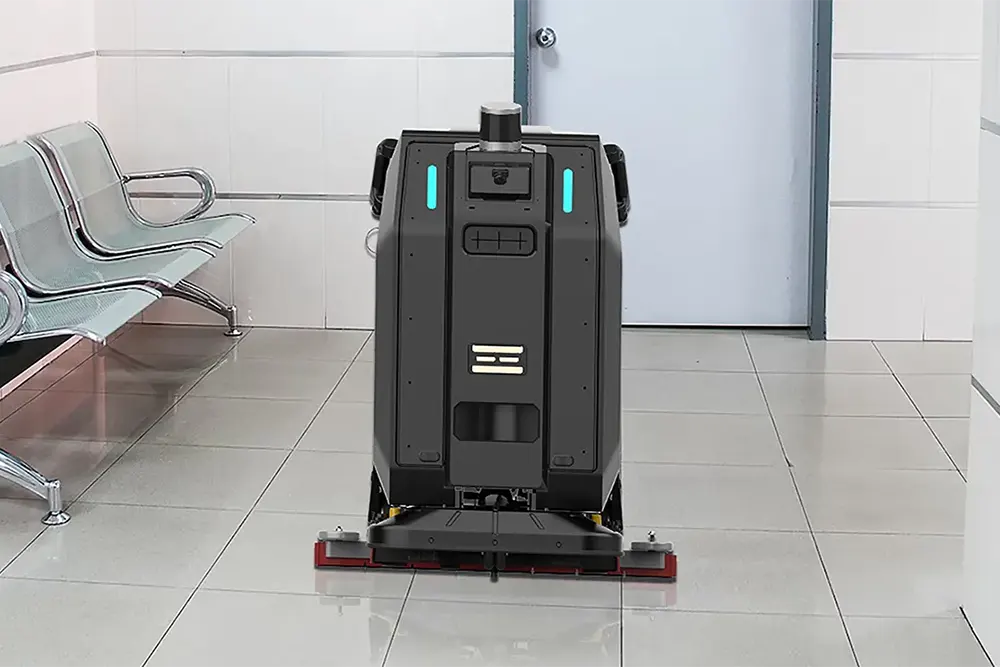
.How CenoBots L3 works where large robots can’t? CenoBots L3 is a compact autonomous robot for washing and drying hard floors, designed for small and medium-sized spaces where passageways, corridors and areas between equipment are limited. With a passage width of 700 mm, a working width of 400 mm and AI navigation, it can operate where larger machines do not have enough space to manoeuvre efficiently.
This makes it particularly suitable for hospitals, schools, hotels, office corridors, smaller stores and other facilities where a large open area is not the main challenge. Compared with other CenoBots cleaning robot models, the L3 stands out for its compact dimensions and ability to operate in confined spaces.
The L3’s advantage lies not only in its dimensions, but also in the combination of a compact body, autonomous navigation and a floor washing and drying system.
How does CenoBots L3 wash and dry floors?
The L3 is a scrubber-dryer robot: it applies a cleaning solution to hard floor surfaces, uses brushes to mechanically remove dirt, and then uses a water recovery system to collect the dirty solution from the floor. It has a working width of 400 mm, 18 kg of brush pressure and separate clean and wastewater tanks with a capacity of 25 litres each.
Its maximum theoretical cleaning capacity is approximately 2,016 m²/h. This figure represents the stated theoretical capacity, while actual productivity within a facility depends on the layout, obstacles, routes and cleaning conditions.
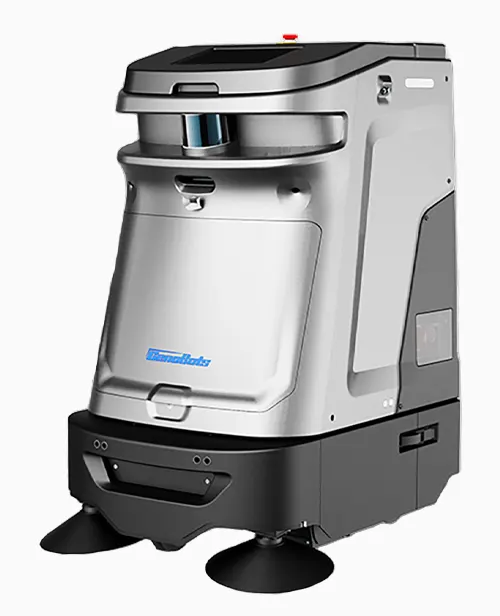
Unlike the S5, which performs dry sweeping and collects loose debris, the L3 is designed for washing and drying hard floor surfaces.
How does L3 know where to go in confined spaces?
The L3 combines 3D LiDAR with an NVIDIA AI platform delivering 100 TOPS for autonomous positioning, path planning and navigation through complex indoor spaces. The system allows the robot to follow a planned route and adapt its movement to the layout, which is particularly important in corridors, aisles between shelves and other confined areas.
The EU CROWDBOT project has also researched the importance of combining sensors, localisation and path planning for the autonomous movement of mobile robots, particularly in changing environments where robots move among people and obstacles.
What does L3 do when an obstacle appears in its path?
When an obstacle appears in its path, L3 uses its perception system to detect it and adjust its movement. CenoBots specifically highlights the recognition of standard obstacles as well as objects close to the floor, such as cables and temporary mats. This reduces the risk of the robot becoming stuck during autonomous operation in changing environments.
This is particularly important for hospitals, schools, retail facilities and offices. However, autonomous obstacle avoidance does not mean that the robot can clean physically inaccessible surfaces. The area underneath or behind an obstacle that blocks access remains outside its working zone until it becomes accessible again.
Which features make the L3 easier to use every day?
CenoBots designed the L3 not only for autonomous navigation but also for easier everyday operation. CenoBots highlights one-touch control, voice commands, magnetic brushes and a quickly removable squeegee. These features simplify task initiation and regular robot maintenance after completed cleaning cycles.
Voice control enables commands such as starting and stopping cleaning, following the operator and returning to the base. CenoBots has also introduced Quick Demo Mode, which allows users to start the robot quickly without prior mapping or setup, primarily for demonstrations and short tasks.
The magnetic brushes and quick-release squeegee system serve a different purpose: they provide easier access to components that require regular maintenance.
How does L3 reduce manual work involving water, detergent and charging?
The L3 can use the WS3 workstation, which combines automatic battery charging, clean water refilling, wastewater drainage and detergent dispensing. This automates some of the tasks between cleaning cycles, so staff do not need to connect the robot manually and manage the tanks each time.
For facilities where suitable water connections are not available in a convenient location, CenoBots also offers a mobile tank with a capacity of 60 L of clean water and 50 L of wastewater.
This does not mean that the L3 operates entirely without maintenance. The brushes, squeegee, tanks and other components still require regular checks and cleaning.
Where does the compact L3 offer the greatest advantage?
The L3 makes the most sense in small and medium-sized facilities with hard floors, narrow passageways and more complex layouts. It is most commonly recommended for hospitals, schools, hotels, stores, smaller supermarkets, office corridors and similar commercial spaces where manoeuvrability and the ability to pass through confined areas matter more than a large cleaning width.
In hospitals, its compact design suits corridors, waiting areas and other accessible hard floor surfaces. In schools, it can operate in corridors and shared spaces, while its narrow design makes it easier to move between shelves in smaller stores.
Hotels and offices face a similar challenge: the total area may not be small, but it can be divided into many corridors and connecting zones. For this reason, the choice of robot should also depend on the minimum passage width, not only on the total number of square metres.
CenoBots L3: key features for confined spaces
| L3 feature | Specification | Why it matters |
| Passage width | 700 mm | Enables operation in narrower passageways |
| Cleaning width | 400 mm | Provides a more compact cleaning width for complex areas |
| Dimensions | 765 × 572 × 1,000 mm | The smaller body makes manoeuvring easier |
| Clean water tank | 25 L | Reduces the need for frequent refilling during cleaning cycles |
| Brush pressure | 18 kg | Provides mechanical scrubbing of hard floors |
| Max. theoretical cleaning capacity | approx. 2,016 m²/h | Delivers productivity despite compact dimensions |
| AI platform | NVIDIA, 100 TOPS | Processes data for autonomous navigation |
| 3D LiDAR | Yes | Supports mapping, navigation and spatial perception |
| WS3 station | Compatible | Charging, water supply, drainage and detergent dispensing |
Is L3 a better choice than a larger robot for every facility?
No. The L3 offers the greatest advantage when the layout requires compact dimensions and manoeuvring through narrower passageways. For large open areas, wider models may offer a more practical working width and greater capacity. The choice of model should therefore depend on a combination of floor area, passage width, obstacle layout and task type
For example, CenoBots L50 is designed for larger industrial and commercial areas, while the L4 is intended for medium-sized spaces and more precise edge cleaning. The L3 fills a different niche: autonomous floor washing where space is limited.
Therefore, “larger” does not automatically mean “better”. A robot with a greater working width on paper has no advantage if it cannot practically move through key parts of the facility.
How CenoBots L3 works where large robots can’t – FAQ
Can L3 completely replace cleaning staff?
No. The L3 can automate repetitive washing of accessible hard floors, while staff remain necessary for stairs, hard-to-reach areas, detailed cleaning, robot maintenance and other tasks that the machine cannot perform. CenoBots also presents its autonomous robots as a supplement to staff rather than a universal replacement for all cleaning tasks.
How long can CenoBots L3 operate on a single charge?
CenoBots L3 can operate for up to approximately 4 hours in ECO mode, depending on the settings and operating conditions. It uses a 60 Ah / 25.6 V LFP battery, while charging takes approximately 1.5 to 2 hours. The actual cycle duration depends on the cleaning mode and the robot’s workload.
Can L3 operate on floors with a slight incline?
Yes. CenoBots L3 can operate on inclines of up to approximately 8%, which is useful in facilities with gentle ramps or transitions between zones. This does not mean that it is designed for steep ramps or stairs, but for surfaces that remain within its stated operating limits.
Compact where needed. Autonomous where it matters.
Discover what L3 can do in your facility.
About the author:
Milja Tonić – SEO Content Strategist & Copywriter
Milja Tonić is an SEO Content Strategist and Copywriter who specialises in creating expert content in the fields of facility management, professional maintenance of commercial facilities and cleaning process automation.
Through research, SEO strategy and original content development, she creates content about professional hygiene, facility management and the use of autonomous cleaning robots in various business environments.